

Straight line:
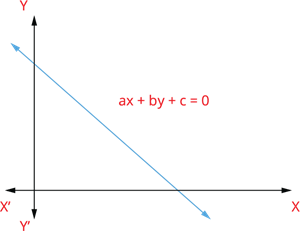
An equation of first degree and of the form \(ax + by + c = 0\) is called as "straight line" in \(xy\) - plane.
Here, \(x\) and \(y\) are variables,
\(a\), \(b\) and \(c\) are real numbers, and atleast one of \(a\), \(b\) are non - zero.
The graphical representation of a straight line is:
Equation of coordinate axes:
The \(X\) - axis and \(Y\) - axis together form the graph, and they are called the cartesian plane or the coordinate axes.
A point on the coordinate axes:
- If a point lies on the \(x\) - axis, then the coordinate of the point is \((x,0)\).
The equation of a point lying on the \(x\) - axis is \(y = 0\).
- If a point lies on the \(y\) axis, then the coordinate of the point is \((0,y)\).
The equation of the point on the \(y\) axis is \(x = 0\).
Equation of a straight line parallel to \(x\) axis:
Consider drawing a line parallel to \(x\) - axis, which is at a distance of \(b\) units. Then, the \(y\) coordinate of every point on the straight line will be "\(b\)".
Hence, the general equation of the line parallel to \(x\) - axis is \(y = b\).
Equation of a straight line parallel to \(y\) axis:
Consider drawing a line parallel to y - axis, which is at a distance of \(b\) units. Then, the \(x\) coordinate of every point on the straight line will be "\(b\)".
Hence, the general equation of the line parallel to \(y\) - axis is \(x = b\).
Hence, the general equation of the line parallel to \(y\) - axis is \(x = b\).
Equation of straight line in various forms:
Slope Intercept form:
The equation of the slope intercept form of the line is given by:
\(y = mx + c\)
where \(m\) is the slope of the line, and
\(c\) is the \(y\) - intercept of the line.
Point slope form:
The equation of the straight line passing through the point \(A(x_1,y_1)\) and having slope \(m\).
\((x - x_1)m = y - y_1\)
Two point form:
The equation of the line in two point form is:
\(\frac{y - y_1}{y_2 - y_1} = \frac{x - x_1}{x_2 - x_1}\)
Where \((x_1,y_1)\) and \((x_2,y_2)\) are coordinates of two distinct points.
Intercept form:
The equation of the straight line in intercept form is:
\(\frac{x}{a} + \frac{y}{b} = 1\)
Where \(a\) and \(b\) are the intercepts of the straight line on the coordinate axes, respectively.
Equation of line parallel, perpendicular and point of intersection:
- Equation of a line parallel to \(ax+by+c=0\)
The equations of all lines parallel to \(ax+by+c=0\) are of the form \(ax+by+k=0\), for different values of \(k\).
- Equation of a line perpendicular to \(ax+by+c=0\)
The equations of all lines perpendicular to \(ax+by+c=0\) are of the form \(bx−ay+k=0\), for different values of \(k\).
- The point of intersection of two intersecting straight lines
If two straight lines are not parallel, then the lines must intersect at some point. Hence, the point of intersection of these two straight lines can be determined by solving the equations.
Slope of a straight line:
The general form of the equation of the straight line is \(ax + by + c = 0\).
Here, the coefficient of \(x = a\).
Coefficient of \(y = b\).
Constant term \(= c\).
The slope is \(m = -\frac{a}{b}\), and the \(y\)-intercept is \(-\frac{c}{b}\).
Slope \(m = - \frac{\text{Coefficient of x}}{\text{Coefficient of y}}\) and \(y\)-intercept is \(-\frac{\text{Constant term}}{\text{Coefficient of y}}\)