

Area of the triangle:
The area of a triangle \(ABC\) having the vertices \(A (x_1, y_1)\), \(B (x_2, y_2)\) and \(C (x_3, y_3)\) taken in order is computed using the following formula.
Area of \(\Delta ABC\) \(=\) \(\frac{1}{2}\left[x_1 \left(y_2 - y_3\right) + x_2 \left(y_3 - y_1\right) + x_3 \left(y_1 - y_2\right)\right]\) square units.
Another form of the formula:
The above given formula can also be written as follows:
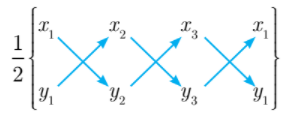
Area of \(\Delta ABC\) \(=\) \(\frac{1}{2}\left[ \left(x_1y_2 + x_2y_3 + x_3y_1\right) - \left(x_2y_1 + x_3y_2 + x_1y_3\right)\right]\) square units.
The above formula can be easily remembered using the following pictorial representation.
 |
Collinearity of the points:
Three or more points are said to be collinear if they lie on the same line.
If the area of the triangle joining the points \((x_1, y_1)\), \((x_2, y_2)\) and \((x_3, y_3)\) is zero, then the points are said to be collinear.
Mathematically, \(\frac{1}{2}\left[x_1 \left(y_2 - y_3\right) + x_2 \left(y_3 - y_1\right) + x_3 \left(y_1 - y_2\right)\right]\) \(=\) \(0\).
Mathematically, \(\frac{1}{2}\left[x_1 \left(y_2 - y_3\right) + x_2 \left(y_3 - y_1\right) + x_3 \left(y_1 - y_2\right)\right]\) \(=\) \(0\).
Another condition for collinearity:
If the points \((x_1, y_1)\), \((x_2, y_2)\) and \((x_3, y_3)\) are collinear, then:
\(x_1 \left(y_2 - y_3\right) + x_2 \left(y_3 - y_1\right) + x_3 \left(y_1 - y_2\right)\) \(=\) \(0\) (or)
If the points \((x_1, y_1)\), \((x_2, y_2)\) and \((x_3, y_3)\) are collinear, then:
\(x_1 \left(y_2 - y_3\right) + x_2 \left(y_3 - y_1\right) + x_3 \left(y_1 - y_2\right)\) \(=\) \(0\) (or)
\(x_1y_2 + x_2y_3 + x_3y_1\) \(=\) \(x_2y_1 + x_3y_2 + x_1y_3\)
Area of the quadrilateral:
The area of the quadrilateral \(ABCD\) having the vertices \(A (x_1, y_1)\), \(B (x_2, y_2)\), \(C (x_3, y_3)\) and \(D (x_4, y_4)\) taken in order is computed using the following formula.
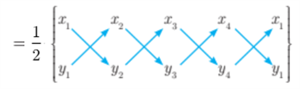
Area of the quadrilateral \(ABCD\) \(=\) \(\frac{1}{2}\left[\left(x_1y_2 + x_2y_3 + x_3y_4 + x_4y_1\right) - \left(x_2y_1 + x_3y_2 + x_4y_3 + x_1y_4\right)\right]\)
The formula can be easily remembered using the following pictorial representation.
The formula can be easily remembered using the following pictorial representation.
Another form of the formula:
Area of the quadrilateral \(ABCD\) \(=\) \(\frac{1}{2}\left[\left(x_1 - x_3\right)\left(y_2 - y_4\right) - \left(x_2 - x_4\right)\left(y_1 - y_3\right)\right]\) square units.
Area of the quadrilateral \(ABCD\) \(=\) \(\frac{1}{2}\left[\left(x_1 - x_3\right)\left(y_2 - y_4\right) - \left(x_2 - x_4\right)\left(y_1 - y_3\right)\right]\) square units.
Inclination of a line:
The angle formed between a straight line and the positive direction of the \(X\)-axis in the anti-clockwise direction is called an inclination of a line or the angle of inclination of a line. It is usually denoted by \(θ\).
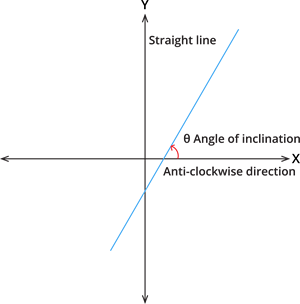
(i) The inclination of the \(X\)-axis and every line parallel to the \(X\)-axis is \(0^\circ\).
(ii) The inclination of the \(Y\)-axis and every line parallel to the \(Y\)-axis is \(90^\circ\).
(ii) The inclination of the \(Y\)-axis and every line parallel to the \(Y\)-axis is \(90^\circ\).
Slope of a straight line:
The measure of steepness is called slope or gradient.
If \(\theta\) is the angle of inclination of a non-vertical straight line, then \(\tan \theta\) is called the slope or gradient of the line and is denoted by \(m\).
Therefore, the slope of the straight line is \(m = \tan \theta\), \(0 \le \theta \le 180^\circ\), \(\theta \ne 90^\circ\).
Therefore, the slope of the straight line is \(m = \tan \theta\), \(0 \le \theta \le 180^\circ\), \(\theta \ne 90^\circ\).
The slope of a straight line when two points are given:
The slope of the line through \((x_1, y_1)\) and \((x_2, y_2)\), with \(x_1 \ne x_2\) is:
\(m = \frac{\text{change in} \ y \ \text{coordinates}}{\text{change in} \ x \ \text{coordinates}}\) \(=\)
- The points are collinear if the slopes between any two pairs of points are equal.
- If two lines are parallel, then their slopes are equal. That is, \(m_1 = m_2\).
- Two lines are perpendicular if and only if the slopes are negative reciprocal of each other. That is, \(m_1 \cdot m_2 = -1\).