

Combined Solids:
A solids formed by combining two or more solids are called combined solids.
- Surface area of combined solids:
The surface area of the solid formed by combining two more solids is obtained by calculating the area of the explicitly visible surfaces.
- Volume of combined solids:
The volume of the solid formed by combining two more solids is obtained by simply calculating the volume of the individual solids and adding them.
Let us recall the formulas related to surface area and volume of three dimensional solids.
Right circular cylinder:
A cylinder whose bases are circular in shape and the axis joining the two centres of the bases perpendicular to the planes of the two bases is called a right circular cylinder.

- Curved surface area of a right circular cylinder \(=\) \(2πrh\) sq. units.
- Total surface area of a right circular cylinder \(=\) \(2πr(r+h)\) sq. units.
- Volume of a right circular cylinder \(=\) \(πr^2h\) cu. units.
Where \(r\) is the radius and \(h\) is the height.
Hollow cylinder:
A cylinder emptied from the inner side and has a difference in the outer and inner radius of a cylinder with the same height is called a hollow cylinder.
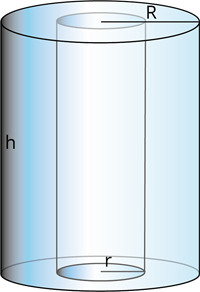
- Curved surface area of a hollow cylinder \(=\) \(2π(R+r)h\) sq. units.
- Total surface area of a hollow cylinder \(=\) \(2π(R+r)(R−r+h)\) sq. units.
- Volume of a hollow cylinder \(=\) \(π(R^2−r^2)h\) cu. units.
Where \(r\) is the inner radius, \(R\) is the outer radius and \(h\) is the height.
Right circular cone:
A right circular cone is a cone whose apex (top vertex of the cone) is perpendicular to the centre of the base of the circle.
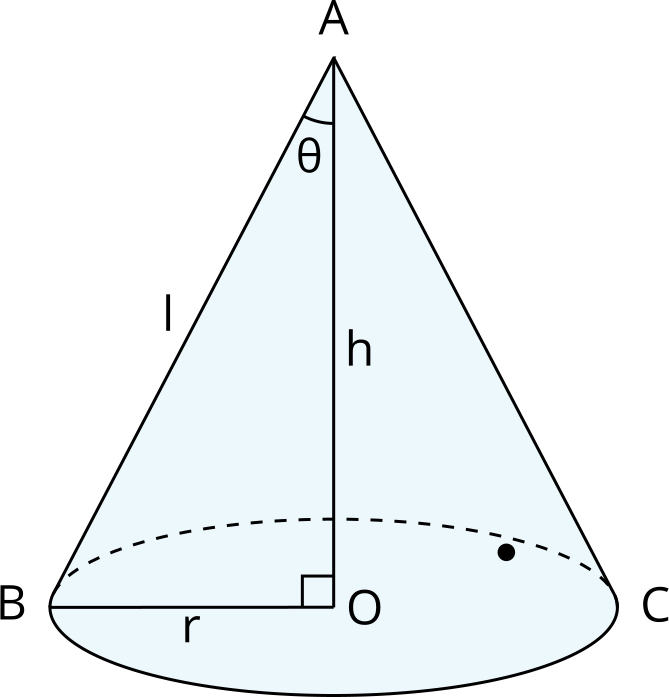
- Slant height \(l = \sqrt{r^2+h^2}\) units
- Curved surface area of a cone \(=\) \(πrl\) sq. units.
- Total surface area of a cone \(=\) \(πr(l+r)\) sq. units.
- Volume of a cone \(=\) \(\frac{1}{3}πr^2h\) cu. units.
Where \(r\) is the radius and \(h\) is the height.
Sphere:
A sphere is a three-dimensional figure obtained by the revolution of a semicircle about its diameter as an axis.
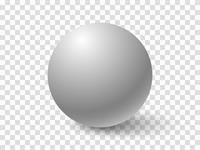
- Surface area of a sphere \(=\) \(4πr^2\) sq. units.
- Volume of a sphere \(=\) \(\frac{4}{3}πr^3\) cu. units.
Where \(r\) is the radius.
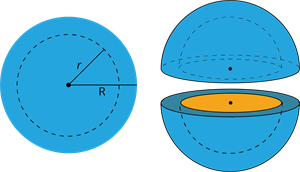
- Volume of a hollow sphere \(=\) \(\frac{4}{3}π(R^3−r^3)\) cu. units.
Where \(r\) is the inner radius and \(R\) is the outer radius.
Hemisphere:
A section of the sphere cut by a plane through any of its great circles is a hemisphere. In another way, we can say, one half of a sphere is called a hemisphere.
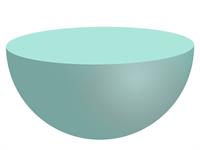
- Curved surface area of a hemisphere \(=\) \(2πr^2\) sq. units.
- Total surface area of a hemisphere \(=\) \(3πr^2\) sq. units.
- Volume of a hemisphere \(=\) \(\frac{2}{3}πr^3\) cu. units.
Where \(r\) is the radius.
Hollow hemisphere:
A hemisphere emptied from the inner side and has a difference in the outer and inner radius of a hemisphere is called a hollow hemisphere.
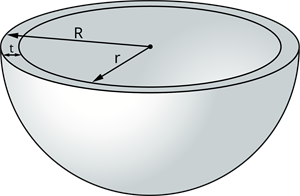
- Curved surface area of a hollow hemisphere \(=\) \(2π(R^2+r^2)\) sq. units.
- Total surface area of a hollow hemisphere \(=\) \(π(3R^2+r^2)\) sq. units.
- Volume of a hollow hemisphere \(=\) \(\frac{2}{3}π(R^3 − r^3)\) cu. units.
Where \(r\) is the inner radius and \(R\) is the outer radius.
Frustum of a cone:
If a smaller end of the cone is sliced by a plane parallel to its base, the portion of a solid between this plane and the base is known as the frustum of a cone.
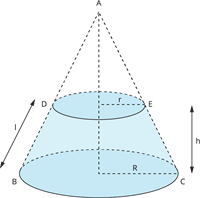
- Slant height, \(l = \sqrt{h^2 + (R−r)^{2}}\) units.
- Curved surface area of a frustum of a cone \(=\) \(π(R+r)l\) sq. units.
- Total surface area of a frustum of a cone \(=\) \(πl(R+r) + πR^2+πr^2\) sq. units.
- Volume of the frustum of a cone \(=\) \(\frac{1}{3}πh[R^2 + Rr + r^2]\) cu. units.
Where \(r\) is the inner radius, \(R\) is the outer radius and \(h\) is the height.