

If the angle of elevation of a cloud from a point '\(h\)' meters above a lake is \(\theta_1\) and the angle of depression of its reflection in the lake is \(\theta_2\). Verify that the height that the cloud is located from the lake is \(\frac{h(tan \ \theta_1 + tan \ \theta_2)}{tan \ \theta_2 - tan \ \theta_1}\).
Explanation:
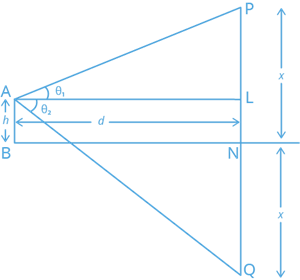
Let \(A\) be the point of observation. Let \(P\) be the cloud, and \(Q\) be the point of its reflection on the lake.
From the given data, we have:
\(AB = h\), \(\angle PAL = \theta_1\), \(\angle LAQ = \theta_2\).
Let \(AL = d\) and \(PN = x\).
In the right \(\triangle PAL\), \(tan \ \theta_1 = \)
\(=\)
\(d = \) ---- (\(1\))
In the right \(\triangle QAL\), \(tan \ \theta_2 = \)
\(tan \ \theta_2 = \)
\(d =\) ---- (\(2\))
From (\(1\)) and (\(2\)), we have:
\(\frac{x - h}{tan \ \theta_1} = \frac{x + h}{tan \ \theta_2}\)
\(tan \ \theta_2\) \(= tan \ \theta_1\)
\(x \ tan \ \theta_2 - \) \(= \)\( + h \ tan \ \theta_1\)
\(x \ tan \ \theta_2 - x \ tan \ \theta_1 = h \ tan \ \theta_2 + h \ tan \ \theta_1\)
\( = h(tan \ \theta_2 + tan \ \theta_1)\)
\(x = h \left(\frac{tan \ \theta_1 + tan \ \theta_2}{tan \ \theta_2 - tan \ \theta_1} \right)\)
Hence, we proved.
Answer variants:
\(htan \ \theta_2\)
\((x+h)\)
\(tan \ \theta_1 = \frac{x-h}{d}\)
\(\frac{x+h}{d}\)
\(\frac{PL}{AL}\)
\((x-h)\)
\(\frac{LQ}{AL}\)
\(xtan \ \theta_1\)
\(\frac{x-h}{tan \ \theta_1}\)
\(x(tan \ \theta_2 - tan \ \theta_1)\)
\(\frac{x+h}{tan \ \theta_2}\)