

Sets
A set is a collection of well-defined, distinguishable objects.
The set is denoted by a capital letter, whereas the elements of a set are represented by small letters written inside the curly braces \(\{ \}\).
Example:
\(A\) is the set of all even numbers less than \(10\).
\(A =\) \(\{2, 4, 6, 8\}\)
We will extend the concept of sets in the following two forms.
- Functions
- Relations
Consider the following graph with some points plotted on it.
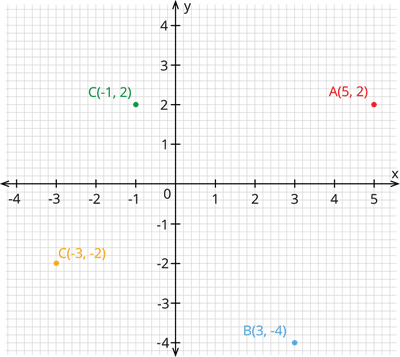 |
Every coordinates \((5,2)\), \((3,-4)\), \((-1,2)\) and \((-3,-2)\) plotted in a graph represents the location of \(A\), \(B\), \(C\) and \(D\) respectively in the graph.
The coordinates are always returned in the same order ( \(x\) - coordinates (Abscissa) followed by \(y\) - coordinates (Ordinate)).
This is an example where we play with the number pairs in mathematics.
Such number pairs are called ordered pairs.
In set language, ordered pairs play a major role in mathematizing relations.
Ordered pairs are a pair of numbers or elements written in a specific order within the parenthesis \((x,y)\).
The first element in the ordered pair represents the element from the first set, and the second element in the ordered pair represents the element from the second set.