

The chapter on "Electricity" is assigned a weightage of \(7\) marks, highlighting its significance in the overall curriculum. Understanding this chapter will enhance to know how basic electrical components connect and their function.
Also to prepare effectively for related exam questions. It is essential to grasp the various types of electrical circuits, components effects, and their applications. Focusing on these concepts will greatly benefit both academic performance and practical application in physics.
- \(1\) mark - Two questions
- \(5\ \)mark - One question
Learning outcomes:
-
Understanding key concepts: Grasp the basic principles of electric current, voltage, and resistance.
-
Applying Ohm’s Law: Use the relationship between voltage, current, and resistance to solve problems.
-
Analyzing circuits: Distinguish between series and parallel circuits and analyze their behaviour.
-
Calculating power and energy: Compute electrical power and energy consumption in various circuits.
-
Heating effect of electric current: Understand the heating effect of electric current and its applications (e.g., electric heaters, fuse).
-
Mathematical applications: Solve problems related to Ohm’s Law and circuit analysis.
Electric charge and current:
| Basis of difference | Electric charge | Electric current |
| Definition | A fundamental property of matter due to which it experiences electrical forces | The amount of charge flowing through a cross-section of a conductor per unit time |
| Symbol | \(q\) or \(Q\) | \(I\) |
| SI Unit | \(coulomb\) (\(C\)) equivalent to the charge contained in nearly \(6\ \times\ 10^{18}\) electrons | \(ampere\) (\(A\)) |
| Formula | \(q\ =\ ne\), here \(e\ =\ 1.6\ \times\ 10^{-19}\ C\) Charge of an electron | \(I\ =\ \frac{Q}{t}\) |
| Quantity | Scalar | Scalar |
One ampere:
One ampere is defined as the amount of current flowing through any cross-section of a conductor when one coulomb of charge flows through it in one second.
\(1\ ampere\ =\ \frac{1\ coulomb}{1\ second}\) or \(1A\ =\ \frac{1C}{1s}\)
Small quantities of current are expressed in milliampere (\(1\ m\ A\ =\ 10^{–3}\ A\)) or in microampere (\(1\ \mu\ A\ =\ 10^{–6}\ A\)).
Conventional current vs electron current:
| Type | Direction | Charge flow |
| Conventional current | Positive to negative | Positive charges |
| Electron current | Negative to positive | Electrons |
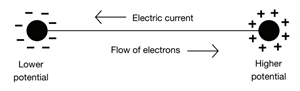
Flow of current
Electric potential vs potential difference:
| Aspect | Electric potential | Potential difference |
| Definition | Work done to bring a unit positive charge from infinity to a point in an electric field. | Work done to move a unit charge between two points in a circuit. |
| Formula | \(V\ =\ \frac{W}{Q}\) (for a point) | \(V\ =\ \frac{W}{Q}\) (between two points) or \(\Delta\ V\ =\ V_2\ -\ V_1\) |
| Unit | \(volt\) (\(V\)) | \(volt\) (\(V\)) |
One volt:
One volt is the potential difference between two points in a current carrying conductor when one joule of work is done to move a charge of one coulomb from one point to the other.
\(1\ volt\ =\ \frac{1\ joule}{1\ coulomb}\) or \(1\ V\ =\ 1\ J\ C^{-1}\)
PYQ: Potential difference
Electric circuit:
An electric circuit is a continuous closed path or loop along which current flows from the positive terminal to the negative terminal of the battery. It has a network of electrical components through which electrons flow.
Electrical components and their symbols:
| Components | Functions | Symbols |
| 1. Electric cell | Converts chemical energy to electrical energy | 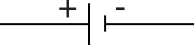 |
| 2. Battery | Combination of cells |  |
| 3. Open switch | Stops current | 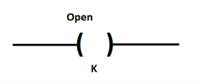 |
| 4. Closed switch | Allows current to flow | 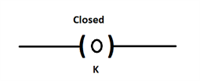 |
| 5. A wire joint | Provide path for current and connects two or more wires | 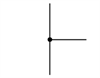 |
| 6. Wires without joint | Wires cross but are not connected electrically | 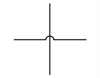 |
| 7. Electric bulb | Converts electrical energy into light |  |
| 8. Resistor | Controls the current and has a constant resistance | 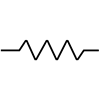 |
| 9. Variable resistance | Regulates current without changing the voltage source | 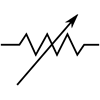 |
| 10. Ammeter | Measures current and connected in series | 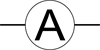 |
| 11. Voltmeter | Measures potential difference and connected in parallel |  |
Ohm's law:
At a constant temperature, the potential difference, \(V\), across the ends of a given metallic conductor in an electric circuit is directly proportional to the current, \(I\) flowing through it.
Mathematically, \(V\ \propto\ I\)
\(I\ =\ (constant)\ V\) or \(\frac{V}{I}\ =\ constant\)
\(\frac{V}{I}\ =\ R\)
\(V\ =\ IR\)
The constant \(R\) is called a resistance and is constant for a given wire at a given temperature.
PYQ: Ohm's law
Resistance:
Resistance is the property of a conductor that opposes the flow of electric charges through it. Its SI unit is the \(ohm\), represented by the Greek letter omega (\(\Omega\)).
\(R\ =\ \frac{V}{I}\) or
\(I\ =\ \frac{V}{R}\)
It is obvious from the above equation that the current through a resistor is inversely proportional to its resistance. If the resistance is doubled the current gets halved.
One ohm:
If the potential difference across the two ends of a conductor is one volt and the current flowing through it is one ampere, then the resistance of the conductor is one ohm.
\(1\ ohm\ =\ \frac{1\ volt}{1\ ampere}\) or \(1\Omega\ =\ \frac{1V}{1A}\)
\(R\ \propto\ \frac{1}{A}\)
This means that a thicker wire (greater area) has lower resistance, while a thinner wire has higher resistance. A larger cross-sectional area provides more space for the movement of electrons, reducing opposition to current flow.
iii. Combined relation of resistance:
By combining the above two relations, we get:
\(R\ \propto\ \frac{l}{A}\)
Introducing a constant of proportionality called resistivity (\(\rho\)), we obtain:
\(R\ =\ \rho\ \frac{l}{A}\)
Resistivity:
Resistivity is a constant that depends on the nature of the material of the conductor. It is a characteristic property of a material and does not depend on its shape or size.
\(\rho\ =\ \frac{RA}{l}\)
SI unit of resistivity:
The SI unit of resistivity is ohm metre (\(\Omega\ m\))
Comparison of materials:
Metals and alloys generally have low resistivity, making them good conductors of electricity. Insulators like rubber and glass have very high resistivity and do not allow current to pass easily.
Tungsten is commonly used in electric bulb filaments due to its high melting point. Copper and aluminium are widely used in electrical transmission lines because they have low resistivity and allow current to flow easily with minimal energy loss.
Exam tips:
- Do not confuse current direction with electron flow.
- Common mistake: Potential difference is measured between two points, whereas electric potential refers to a particular point relative to a reference.
- Do not state that Ohm’s law applies to every electrical device under all conditions and do not forget that Ohm’s law requires constant temperature and unchanged physical conditions.
- Before substituting values, check that voltage is in volts and current is in amperes. Convert milliamperes into amperes when necessary.
- When comparing resistances, check which quantities are kept constant before drawing a conclusion.
- Convert area into \(\text{m}^2\) and length into metres when calculating resistivity in SI units.