

The chapter on "Electricity" is assigned a weightage of \(7\) marks, highlighting its significance in the overall curriculum. Understanding this chapter will enhance to know how basic electrical components connect and their function.
Also to prepare effectively for related exam questions. It is essential to grasp the various types of electrical circuits, components effects, and their applications. Focusing on these concepts will greatly benefit both academic performance and practical application in physics.
- \(1\) mark - Two questions
- \(5\ \)mark - One question
Learning outcomes:
-
Understanding key concepts: Grasp the basic principles of electric current, voltage, and resistance.
-
Applying Ohm’s Law: Use the relationship between voltage, current, and resistance to solve problems.
-
Analyzing circuits: Distinguish between series and parallel circuits and analyze their behaviour.
-
Calculating power and energy: Compute electrical power and energy consumption in various circuits.
-
Heating effect of electric current: Understand the heating effect of electric current and its applications (e.g., electric heaters, fuse).
-
Mathematical applications: Solve problems related to Ohm’s Law and circuit analysis.
Resistors in series vs. parallel:
| Series combination | Parallel combination |
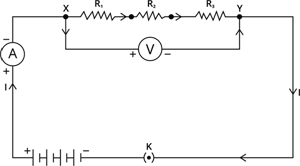 Resistors connected in series
|
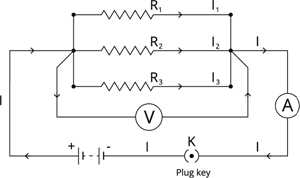 Resistors connected in parallel
|
| Resistors are connected one after another in a single path | Resistors are connected across the same two points, forming separate branches |
| There is only one path for current, so the same current flows through every resistor | Current has multiple paths, so it splits among the branches depending on the resistance |
| The supply voltage is divided among the resistors | The potential difference across each resistor is the same as the battery voltage |
| \(V\ =\ V_1\ +\ V_2\ +\ V_3\) | \(V\ =\ V_1\ =\ V_2\ =\ V_3\) |
| \(I\ =\ I_1\ =\ I_2\ =\ I_3\) | \(I\ =\ I_1\ +\ I_2\ +\ I_3\) |
|
Effective resistance, \(R_s\ =\ R_1\ +\ R_2\ +\ R_3\)
|
Effective resistance, \(\frac{1}{R_p}\ =\ \frac{1}{R_1}\ +\ \frac{1}{R_2}\ +\ \frac{1}{R_3}\) |
|
\(R_s\ =\ nR\)
|
\(R_p\ =\ \frac{R}{n}\) |
| Equivalent resistor \(R_s\) is always greater than any individual resistance | Equivalent resistor \(R_p\) is always lesser than the smallest individual resistance |
|
Entire circuit: \(V\ =\ IR_s\);
Each resistor: \(V_1\ =\ IR_1\), \(V_2\ =\ IR_2\), \(V_3\ =\ IR_3\)
|
Entire circuit: \(I\ =\ \frac{V}{R_p}\);
Each resistor: \(I_1\ =\ \frac{V}{R_1}\), \(I_2\ =\ \frac{V}{R_2}\), \(I_3\ =\ \frac{V}{R_3}\)
|
| Total resistance increases, so current decreases (for the same battery voltage) | Equivalent resistance decreases, so total current drawn from the battery increases |
| If one resisotor breaks, the circuit becomes open, and all components stop working. | Other branches continue to work even if one branch is broken |
| Example: Fairy lights | Example: Domestic electrical wiring |
Common mistakes to avoid:
-
Do not interchange current and voltage in series and parallel combinations.
-
Do not add resistances directly in a parallel combination.
Joule's law of heating:
Consider a resistor of resistance \(R\) connected to a battery.
The electrical work done in moving a charge \(Q\) across a potential difference \(V\) is:
Work done, \(W\ =\ VQ\)
Since electrical energy supplied by the source is equal to the work done,
Electrical Energy, \(E\ =\ VQ\)
As charge is related to current by:
Charge, \(Q\ =\ It\)
Substituting,
Electrical Energy, \(E\ =\ VIt\)
Since all the electrical energy is converted into heat in a purely resistive circuit,
Heat Produced, \(H\ =\ VIt\)
Using Ohm's Law,
\(V\ =\ IR\)
Substituting this in the above equation,
\(H\ =\ (IR)It\)
Therefore,
\(H\ =\ I^2Rt\)
This equation is known as Joule's Law of Heating.
The heat produced in a resistor is directly proportional to the square of the current flowing through it, directly proportional to its resistance, and directly proportional to the time for which the current flows.
Factors affecting heat produced:
- If the current is doubled, the heat produced becomes four times greater.
- A higher resistance produces more heat for the same current.
- The longer the current flows, the greater the amount of heat produced.
Common mistakes to avoid:
-
Do not forget to square the current.
-
Convert time into seconds when calculating heat in joules.
Practical applications of the heating effect of electric current:
- Appliances such as electric irons, heaters, kettles, toasters, and ovens work on the principle of Joule's heating, where electrical energy is converted into heat.
- The heating effect is also used in electric bulbs. A thin tungsten filament, with a very high melting point (\(3380^{\circ}C\)), becomes white-hot and produces light when current passes through it.
- The bulb is filled with nitrogen and argon gases to increase the life of the filament. Most of the electrical energy is converted into heat, while only a small portion is emitted as light.
Electric fuse - An application of Joule's heating:
- An electric fuse is a safety device that works on the principle of Joule's heating.
- It protects electrical circuits and appliances by breaking the circuit when excessive current flows.
- A fuse is connected in series with the appliance and contains a thin wire made of a metal or alloy such as aluminium, copper, iron, or lead with a suitable melting point.
- When the current exceeds the safe limit, the fuse wire heats up, melts, and stops the flow of current.
- Fuse wires are enclosed in a porcelain cartridge and are available in ratings such as \(1\ A\), \(2\ A\), \(3\ A\), \(5\ A\), and \(10\ A\).
PYQ: Fuse and current rating , Fuse
Common mistakes to avoid:
- Do not confuse nichrome with tungsten.
Electric power:
In an electric circuit, the rate at which electrical energy is converted into other forms of energy is called electric power.
Electric power, \(P\ =\ VI\)
Using Ohm's Law, the power equation can also be written as:
\(P\ =\ I^2R\)
\(P\ =\ \frac{V^2}{R}\)
The SI unit of electric power is the watt (\(W\)).
One watt is the power consumed by an electrical device when a current of \(1\ ampere\) flows through it under a potential difference of \(1\ volt\).
Since the watt is a small unit, electrical power is often expressed in kilowatts (\(kW\)).
\(1\ kW\ =\ 1000\ W\)
Commercial unit of electrical energy:
Electrical energy is the product of power and time.
The SI unit of electrical energy is the joule (\(J\)).
However, for commercial purposes, electrical energy is measured in kilowatt-hour (\(kWh\)), commonly called a unit.
\(1\ kWh\ =\ 3.6\ \times\ 10^6\ J\)
Thus, \(1\) unit of electrical energy \(=\ 1\ kWh\ =\ 3.6 \times\ 10^6\ J\)
Common mistakes to avoid:
- Convert watts into kilowatts before calculating units.
- Convert time into hours when calculating energy in kWh.
- Do not confuse power with electrical energy.