

Electricity is the most convenient and controllable form of energy. The origin of electricity lies in electric charges. Electricity is a branch of physics that deals with the flow of electric charges through a conductor.
Electric charge and current:
| Basis of difference | Electric charge | Electric current |
| Definition | A fundamental property of matter due to which it experiences electrical forces | The amount of charge flowing through a cross-section of a conductor per unit time |
| Symbol | \(q\) or \(Q\) | \(I\) |
| SI Unit | \(coulomb\) (\(C\)) equivalent to the charge contained in nearly \(6\ \times\ 10^{18}\) electrons | \(ampere\) (\(A\)) |
| Formula | \(q\ =\ ne\), here \(e\ =\ 1.6\ \times\ 10^{-19}\ C\) Charge of an electron | \(I\ =\ \frac{Q}{t}\) |
| Quantity | Scalar | Scalar |
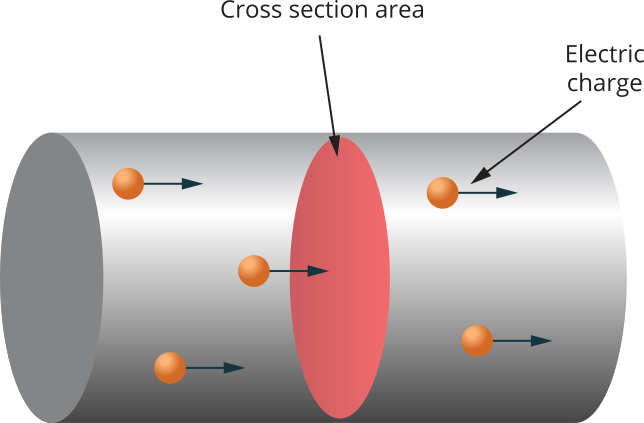
Flow of charges in a conductor
One ampere:
One ampere is defined as the amount of current flowing through any cross-section of a conductor when one coulomb of charge flows through it in one second.
\(1\ ampere\ =\ \frac{1\ coulomb}{1\ second}\) or \(1A\ =\ \frac{1C}{1s}\)
Small quantities of current are expressed in milliampere (\(1\ m\ A\ =\ 10^{–3}\ A\)) or in microampere (\(1\ \mu\ A\ =\ 10^{–6}\ A\)).
Conventional current vs electron current:
| Type | Direction | Charge flow |
| Conventional current | Positive to negative | Positive charges |
| Electron current | Negative to positive | Electrons |
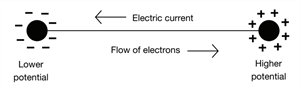
Flow of current
Electric potential vs potential difference:
| Aspect | Electric potential | Potential difference |
| Definition | Work done to bring a unit positive charge from infinity to a point in an electric field. | Work done to move a unit charge between two points in a circuit. |
| Formula | \(V\ =\ \frac{W}{Q}\) (for a point) | \(V\ =\ \frac{W}{Q}\) (between two points) or \(\Delta\ V\ =\ V_2\ -\ V_1\) |
| Unit | \(volt\) (\(V\)) | \(volt\) (\(V\)) |
One volt:
One volt is the potential difference between two points in a current carrying conductor when one joule of work is done to move a charge of one coulomb from one point to the other.
\(1\ volt\ =\ \frac{1\ joule}{1\ coulomb}\) or \(1\ V\ =\ 1\ J\ C^{-1}\)
Electric circuit:
An electric circuit is a continuous closed path or loop along which current flows from the positive terminal to the negative terminal of the battery. It has a network of electrical components through which electrons flow.
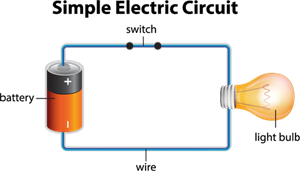
Electric circuit
Electrical components and their symbols:
| Components | Functions | Symbols |
| 1. Electric cell | Converts chemical energy to electrical energy | 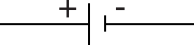 |
| 2. Battery | Combination of cells |  |
| 3. Open switch | Stops current | 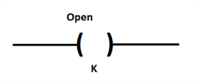 |
| 4. Closed switch | Allows current to flow | 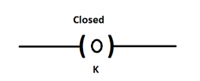 |
| 5. A wire joint | Provide path for current and connects two or more wires | 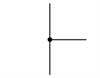 |
| 6. Wires without joint | Wires cross but are not connected electrically | 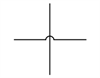 |
| 7. Electric bulb | Converts electrical energy into light |  |
| 8. Resistor | Controls the current and has a constant resistance |  |
| 9. Variable resistance | Regulates current without changing the voltage source |  |
| 10. Ammeter | Measures current and connected in series |  |
| 11. Voltmeter | Measures potential difference and connected in parallel |  |
Ohm's law:
In 1827, Georg Simon Ohm, a German physicist, found out the relationship between the current \(I\) and the potential difference \(V\).
At a constant temperature, the potential difference, \(V\), across the ends of a given metallic conductor in an electric circuit is directly proportional to the current, \(I\) flowing through it.
Mathematically, \(V\ \propto\ I\)
\(I\ =\ (constant)\ V\) or \(\frac{V}{I}\ =\ constant\)
\(\frac{V}{I}\ =\ R\)
\(V\ =\ IR\)
The constant \(R\) is called a resistance and is constant for a given wire at a given temperature.
Resistance:
Resistance is the property of a conductor that opposes the flow of electric charges through it. Its SI unit is the \(ohm\), represented by the Greek letter omega (\(\Omega\)).
\(R\ =\ \frac{V}{I}\) or
\(I\ =\ \frac{V}{R}\)
It is obvious from the above equation that the current through a resistor is inversely proportional to its resistance. If the resistance is doubled the current gets halved.
One ohm:
If the potential difference across the two ends of a conductor is one volt and the current flowing through it is one ampere, then the resistance of the conductor is one ohm.
\(1\ ohm\ =\ \frac{1\ volt}{1\ ampere}\) or \(1\Omega\ =\ \frac{1V}{1A}\)
Experimental verification of Ohm's law:
Activity: To verify the relationship between potential difference (\(V\)) and current (\(I\)) in a conductor and hence verify Ohm’s law.
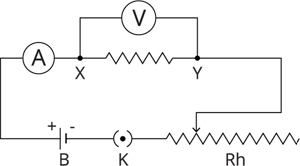
Experimental setup
Step 1: Arrange the apparatus: connect the cells, nichrome wire, ammeter, and key in series, and connect the voltmeter in parallel across the nichrome wire.
Step 2: Close the key using one cell and note the readings of current (\(I\)) and potential difference (\(V\)).
Step 3: Repeat the experiment using two, three, and four cells, noting the corresponding values of current and voltage each time.
Step 4: Record all readings in a table and calculate the ratio \(R = V/I\) for each observation.
Step 5: Plot a graph between \(V\) (y-axis) and \(I\) (x-axis).
Observation:
| No. of cells | Current (\(I\)) in (\(A\)) | Potential difference (\(V\)) in (\(V\)) | Resistance (\(R\)) in (\(\Omega\)) |
| 1 | 0.2 | 1.0 | 5 |
| 2 | 0.4 | 2.0 | 5 |
| 3 | 0.6 | 3.0 | 5 |
| 4 | 0.8 | 4.0 | 5 |
- The value of \(V/I\) remains constant.
- The graph between \(V\) and \(I\) is a straight line passing through the origin.
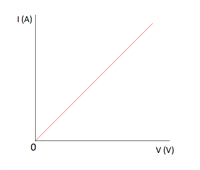
Graphical representation of Ohm's law
Conclusion: