

Joule's law of heating:
Consider a resistor of resistance \(R\) connected to a battery.
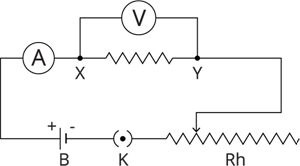
An electric circuit
The electrical work done in moving a charge \(Q\) across a potential difference \(V\) is:
Work done, \(W\ =\ VQ\)
Since electrical energy supplied by the source is equal to the work done,
Electrical Energy, \(E\ =\ VQ\)
As charge is related to current by:
Charge, \(Q\ =\ It\)
Substituting,
Electrical Energy, \(E\ =\ VIt\)
Since all the electrical energy is converted into heat in a purely resistive circuit,
Heat Produced, \(H\ =\ VIt\)
Using Ohm's Law,
\(V\ =\ IR\)
Substituting this in the above equation,
\(H\ =\ (IR)It\)
Therefore,
\(H\ =\ I^2Rt\)
This equation is known as Joule's Law of Heating.
The heat produced in a resistor is directly proportional to the square of the current flowing through it, directly proportional to its resistance, and directly proportional to the time for which the current flows.
Factors affecting heat produced:
According to Joule's Law:
1. Heat is directly proportional to the square of the current (\(I^2\)).
If the current is doubled, the heat produced becomes four times greater.
2. Heat is directly proportional to the resistance (\(R\)).
A higher resistance produces more heat for the same current.
3. Heat is directly proportional to the time (\(t\)).
The longer the current flows, the greater the amount of heat produced.
Practical applications of the heating effect of electric current:
- Appliances such as electric irons, heaters, kettles, toasters, and ovens work on the principle of Joule's heating, where electrical energy is converted into heat.
- The heating effect is also used in electric bulbs. A thin tungsten filament, with a very high melting point (\(3380^{\circ}C\)), becomes white-hot and produces light when current passes through it.
- The bulb is filled with nitrogen and argon gases to increase the life of the filament. Most of the electrical energy is converted into heat, while only a small portion is emitted as light.
Electric fuse - An application of Joule's heating:
- An electric fuse is a safety device that works on the principle of Joule's heating.
- It protects electrical circuits and appliances by breaking the circuit when excessive current flows.
- A fuse is connected in series with the appliance and contains a thin wire made of a metal or alloy such as aluminium, copper, iron, or lead with a suitable melting point.
- When the current exceeds the safe limit, the fuse wire heats up, melts, and stops the flow of current.
- Fuse wires are enclosed in a porcelain cartridge and are available in ratings such as \(1\ A\), \(2\ A\), \(3\ A\), \(5\ A\), and \(10\ A\).
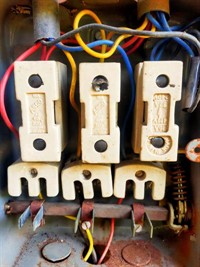
Electric fuse
Electric power:
In an electric circuit, the rate at which electrical energy is converted into other forms of energy is called electric power.
Electric power, \(P\ =\ VI\)
Using Ohm's Law, the power equation can also be written as:
\(P\ =\ I^2R\)
\(P\ =\ \frac{V^2}{R}\)
The SI unit of electric power is the watt (\(W\)).
One watt is the power consumed by an electrical device when a current of \(1\ ampere\) flows through it under a potential difference of \(1\ volt\).
Since the watt is a small unit, electrical power is often expressed in kilowatts (\(kW\)).
\(1\ kW\ =\ 1000\ W\)
Commercial unit of electrical energy:
Electrical energy is the product of power and time.
The SI unit of electrical energy is the joule (\(J\)).
However, for commercial purposes, electrical energy is measured in kilowatt-hour (\(kWh\)), commonly called a unit.
\(1\ kWh\ =\ 3.6\ \times\ 10^6\ J\)
Thus, \(1\) unit of electrical energy \(=\ 1\ kWh\ =\ 3.6 \times\ 10^6\ J\)