

System of resistors:
In an electric circuit, the amount of current flowing through a conductor depends on its resistance and the potential difference applied across it, as explained by Ohm's Law. In practical electrical devices and appliances, a single resistor is often not sufficient to achieve the required resistance. Therefore, resistors are connected together in different combinations to obtain the desired electrical characteristics.
The total resistance of a circuit depends on how the resistors are connected. There are two basic methods of connecting resistors:
- Series combination
- Parallel combination
Resistors in series vs. parallel:
| Series combination | Parallel combination |
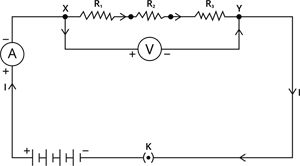 Resistors connected in series
|
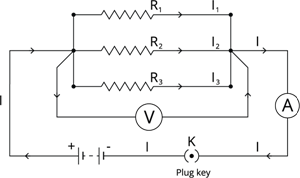 Resistors connected in parallel
|
| Resistors are connected one after another in a single path | Resistors are connected across the same two points, forming separate branches |
| There is only one path for current, so the same current flows through every resistor | Current has multiple paths, so it splits among the branches depending on the resistance |
| The supply voltage is divided among the resistors | The potential difference across each resistor is the same as the battery voltage |
| \(V\ =\ V_1\ +\ V_2\ +\ V_3\) | \(V\ =\ V_1\ =\ V_2\ =\ V_3\) |
| \(I\ =\ I_1\ =\ I_2\ =\ I_3\) | \(I\ =\ I_1\ +\ I_2\ +\ I_3\) |
|
Effective resistance, \(R_s\ =\ R_1\ +\ R_2\ +\ R_3\)
|
Effective resistance, \(\frac{1}{R_p}\ =\ \frac{1}{R_1}\ +\ \frac{1}{R_2}\ +\ \frac{1}{R_3}\) |
|
\(R_s\ =\ nR\)
|
\(R_p\ =\ \frac{R}{n}\) |
| Equivalent resistor \(R_s\) is always greater than any individual resistance | Equivalent resistor \(R_p\) is always lesser than the smallest individual resistance |
|
Entire circuit: \(V\ =\ IR_s\);
Each resistor: \(V_1\ =\ IR_1\), \(V_2\ =\ IR_2\), \(V_3\ =\ IR_3\)
|
Entire circuit: \(I\ =\ \frac{V}{R_p}\);
Each resistor: \(I_1\ =\ \frac{V}{R_1}\), \(I_2\ =\ \frac{V}{R_2}\), \(I_3\ =\ \frac{V}{R_3}\)
|
| Total resistance increases, so current decreases (for the same battery voltage) | Equivalent resistance decreases, so total current drawn from the battery increases |
| If one resisotor breaks, the circuit becomes open, and all components stop working. | Other branches continue to work even if one branch is broken |
| Example: Fairy lights | Example: Domestic electrical wiring |