

The chapter on light reflection and refraction is assigned a weightage of \(7\) to \(8\) marks, highlighting its significance in the overall curriculum. Understanding this chapter will enhance to know behaviour of light and using ray diagrams to illustrate concepts and explain real-life applications of optics.
Also to prepare effectively for related exam questions. It is essential to grasp the concepts of reflection and refraction and image formation by mirrors. Focusing on these concepts will greatly benefit both academic performance and practical application in physics.
In the below, we have provided the details of the question distribution among the different sections.
- \(1\ \)mark - One question
- \(2\) mark - One question
- \(4\) / \(5\) mark - One question
Learning outcomes:
- Introduction to light: Understanding the nature and properties of light.
- Laws of reflection and refraction: Applying the laws of reflection and refraction to practical situations.
- Analyzing image formation in mirrors using ray diagrams: Outline the rule of image formation by spherical mirrors in order to complete the ray diagrams by drawing reflected rays.
Refraction:
Refraction occurs when light travels from one transparent medium to another at a different speed.
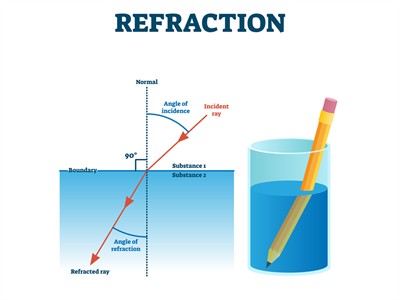
Refraction of light
The following are the laws of refraction of light.
- The incident ray, the refracted ray and the normal ray to the interface of two transparent media at the point of incidence all lie in the same plane.
- The ratio of the sine of the angle of incidence to the sine of the angle of refraction is a constant for the light of a given colour and the given pair of media. This law is also known as Snell’s law of refraction. (This is true for angle 0°<i<90°)
If \(i\) is the angle of incidence and \(r\) is the angle of refraction, then
\(\frac{sin\ i}{sin\ r}\ =\ constant\)
Refraction through glass slab:
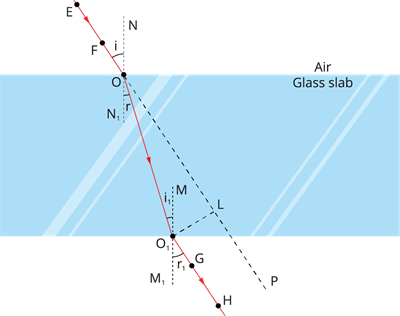
Refraction through glass slab
Incident ray (\(EF\)) strikes at \(O\)
\(\downarrow\)
Angle of incidence (\(i\)) formed between \(EF\) and normal (\(NN_1\))
\(\downarrow\)
Refracted ray bends towards normal (\(NN_1\))
\(\downarrow\)
Angle of refraction (\(r\)) formed between ray and normal (\(NN_1\))
\(\downarrow\)
Ray reaches second surface at \(O_1\)
\(\downarrow\)
Angle of incidence inside slab (\(i_1\)) formed between ray and normal (\(MM_1\))
\(\downarrow\)
Emergent ray (\(GH\)) comes out through \(O_1\) and bends away from normal
\(\downarrow\)
Emergent ray (\(GH\)) parallel to incident ray (\(EF\))
\(\downarrow\)
Dashed line (\(OL\)) shows original path of incident ray
\(\downarrow\)
Distance between (\(OL\)) and emergent ray is the lateral displacement
Emergent ray:
The emergent ray is the ray that comes out of the second surface of the glass slab.
Lateral displacement:
Lateral displacement is the perpendicular distance between the original path of the incident ray and the path of the emergent ray.
The emergent ray is parallel but shifted sideways. No lateral displacement occurs if the light is incident normally (angle of incidence \(=\ 0^{\circ}\)).
Factors affecting lateral displacement:
- Thickness of slab: More thickness = more shift
- Angle of incidence: Larger angle = more shift
- Refractive index: Denser medium = more shift
- Colour of light: Violet = more shift, Red = less shift
A medium's absolute refractive index is simply referred to as its refractive index.
The refractive index of water is \(n_w\ =\ 1.33\).
This means that the ratio of light speed in air to light speed in water is equal to \(1.33\).
Similarly, crown glass has a refractive index of \(n_g\ =\ 1.52\).
Exam tips:
1. Refractive index
2. Finding medium
3. Values to be notes
4. Formula
Lens:
A lens is formed by a transparent material bound by two surfaces, one or both of which are spherical. A lens is bound by at least one spherical surface in this case. Planes would be the other surface in such lenses.
A lens has two spherical surfaces, one convex and the other concave. Each of these surfaces is a sphere in its own right.
Image formation by convex lens:
| Object position | Image position | Nature and size |
| At infinity | At \(F_2\) | Real, inverted and highly diminished |
| Beyond \(2F_1\) | Between \(F_2\) and \(2F_2\) | Real, inverted and diminished |
| At \(2F_1\) | At \(2F_2\) | Real, inverted and same size |
| Between \(F_1\) and \(2F_1\) | Beyond \(2F_2\) | Real, inverted and enlarged |
| At \(F_1\) | At infinity | Image would not be formed |
| Between \(F_1\) and \(O\) | On the same side of the lens as the object | Virtual, erect and enlarged |
Image formation by concave lens:
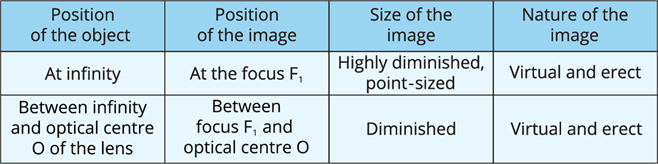
Image formation by concave lens
The lens equation is given by
\(\frac{1}{f}\ =\ \frac{1}{v}\ -\ \frac{1}{u}\)
The magnification is given by
\(M\ =\ \frac{v}{u}\ =\ \frac{h'}{h_o}\)
Power of a lens:
The power of a lens is the degree of convergence or divergence of light rays it achieves. A lens's power is equal to the reciprocal of its focal length. It is denoted by the letter P. The power P of a lens with a focal length of f is calculated as follows:
\(P\ =\ \frac{1}{f}\)
The 'dioptre' is the SI unit of lens power. The letter \(D\) stands for it. When f is measured in metres, power is measured in dioptres.
A lens with a focal length of one metre has a power of one dioptre.
The power of a convex lens is positive, while the power of a concave lens is negative.
PYQ:
Exam tip:
1. Type of lens
2. Sign concention
3. Unit conversion
4. Magnification