

Light travels in straight lines, as seen when a small source casts sharp shadows, forming a ray of light. On polished surfaces like mirrors, most light is reflected, following the laws of reflection.
A spherical mirror's reflecting surface can be curved inwards or outwards.
Concave mirror - a reflecting surface that is curved inward.
Convex mirror - a reflecting surface that is curved outward.
There are two types image formed in the mirror,
Real image - The image is obtained on the screen
Virtual image - The image can not be obtained on the screen
Terms related to spherical mirrors:
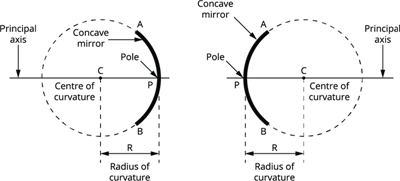
Terminologies of spherical mirror
Concave mirror - converging mirror
Convex mirror - diverging mirror
The radius of curvature of small aperture spherical mirrors is found to be equal to twice the focal length,
\(R\ =\ 2f\)
This indicates that the principal focus of a spherical mirror lies midway between the pole and centre of curvature.
Representation of image formation using ray diagrams:
|
A ray parallel to the principal axis, after reflection, will pass through the principal focus in the case of a concave mirror or appear to diverge from the principal focus in the case of a convex mirror.
|
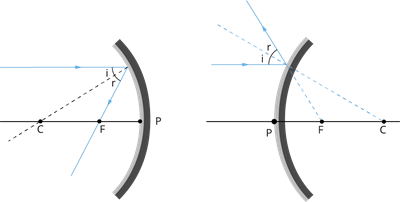 |
| A ray passing through the principal focus of a concave mirror or a ray that is directed towards the principal focus of a convex mirror, after reflection, will emerge parallel to the principal axis. | 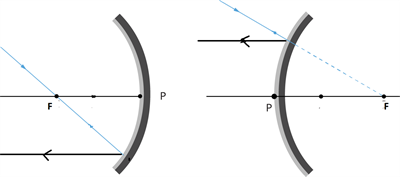 |
| A ray passing through the centre of curvature of a concave mirror or directed in the direction of the centre of curvature of a convex mirror, after reflection, is reflected back along the same path. | 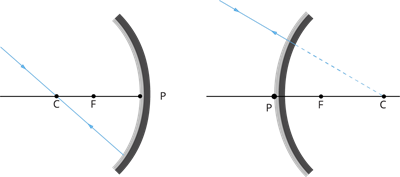 |
| A ray incident obliquely to the principal axis, towards a point P (pole of the mirror), on the concave mirror, is reflected obliquely. The incident and reflected rays follow the laws of reflection at the point of incidence (point P), making equal angles with the principal axis.
|
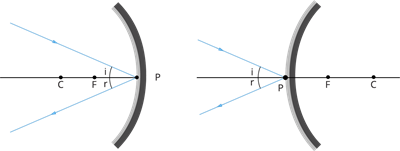 |
Image formation by concave mirror:
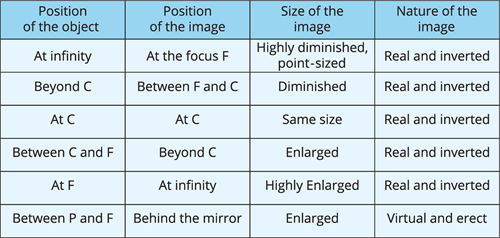
Sign convention:
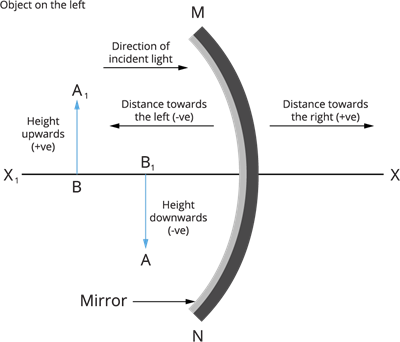
Note:
- The object distance is always negative.
- The height of the object is always positive.
Mirror formula and magnification:
The mirror formula, which is expressed as shows a relationship between these three quantities.
\(\frac{1}{f}\ =\ \frac{1}{u}\ +\ \frac{1}{v}\)
The magnification can be related to object distance (u) and the image distance (v).
\(m\ =\ \frac{-v}{u}\)
(or)
\(m\ =\ \frac{h'}{h_o}\) =\( \frac{-v}{u} \)
The presence of a negative sign in the magnification value indicates that the image is real.
The presence of a positive sign in the magnification value indicates that the image is virtual.
\(m\ <\ 1\) − The image formed is enlarged.
\(m\ <\ 1\) − The image formed is diminished.