

Rules for drawing ray diagram in concave lens:
| Rule No. | Incident ray | Refracted ray | Ray diagram |
| 1. | A ray parallel to the principal axis | Appears to diverge from the principal focus on the same side of the lens | 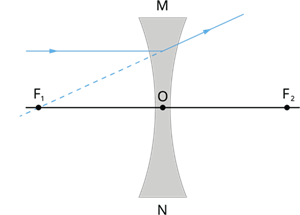 |
| 2. | A ray directed towards the principal focus | Emerge parallel to the principal axis | 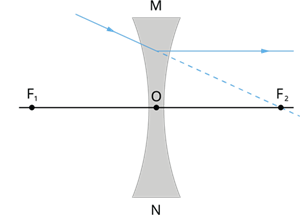 |
| 3. | A ray passing through the optical centre | Emerges without any deviation (continues in the same straight line) | 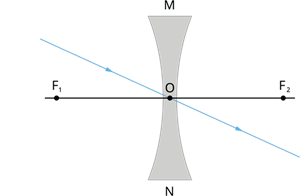 |
Image formation by concave lens:
| Object position | Image position | Nature and size | Ray diagram |
| At infinity | At \(F_1\) | Virtual, erect, highly diminished and point-sized | 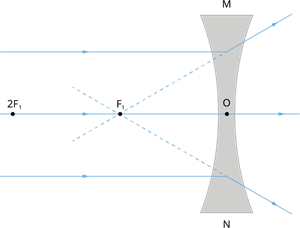 |
| Between infinity and \(O\) | Between \(F_1\) and \(O\) | Virtual, erect and diminished | 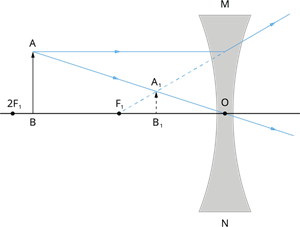 |
Sign convention for concave lens:
| Quantity | Symbol | Sign convention |
| Object distance | \(u\) | Always negative |
| Image distance | \(v\) |
Always negative
|
| Focal length | \(f\) | Always negative |
| Object height | \(h_o\) | Always positive |
| Image height | \(h_i\) |
Always positive
|
Lens formula:
\(\frac{1}{f}\ =\ \frac{1}{v}\ -\ \frac{1}{u}\)
Magnification:
\(m\ =\ \frac{v}{u}\ =\ \frac{h_i}{h_o}\)
| Magnification value | Nature of image |
| \(m\ >\ 1\) | Enlarged |
| \(m\ =\ 1\) | Same size |
| \(m\ <\ 1\) | Diminished |
| \(m\) is positive | Virtual, erect |
| \(m\) is negative | Real, inverted |
Power of lens:
\(P\ =\ \frac{1}{f}\)
Unit of power is dioptre (\(D\))
For concave lens: \(P\) is negative.