

Lens:
A lens is formed from a transparent material bound by two surfaces, one or both of which are spherical. A lens may have two convex surfaces, two concave surfaces, one convex and the other concave or one plane and one curved surface. Each curved surface is a part of a sphere
Converging lens - Convex lens
Diverging lens - Concave lens
Rule 1:
A ray of light from the object, parallel to the principal axis, after refraction from a convex lens, passes through the principal focus on the other side of the lens.
In the case of a concave lens, the ray appears to diverge from the principal focus located on the same side of the lens, as shown in the figure below.
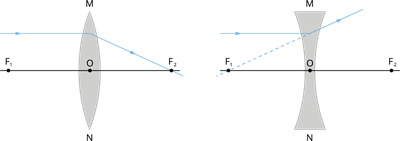
Rule 2:
A ray of light passing through the principal focus, after refraction from a convex lens, will emerge parallel to the principal axis.
A ray of light directed towards the principal focus of a concave lens, after refraction, will emerge parallel to the principal axis.
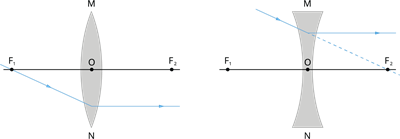
Rule 3:
A ray of light passing through the optical centre of a lens will emerge without deviation.
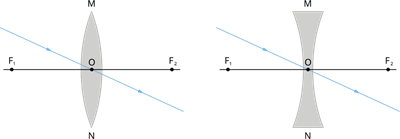
Image formation by convex lens:
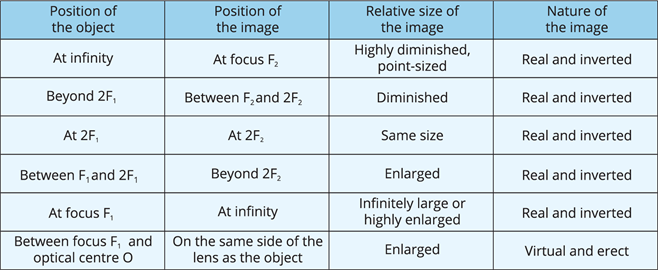
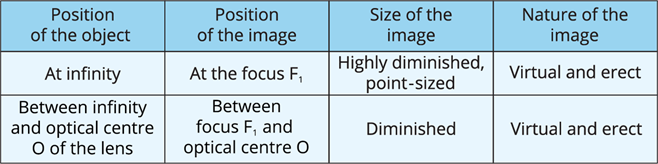
Image formation by concave lens:
The lens equation is given by,
\(\frac{1}{f}\ =\ \frac{1}{v}\ -\ \frac{1}{u}\)
The magnification is given by,
\(M\ =\ \frac{v}{u}\ =\ \frac{h'}{h_o}\)
Power of a lens:
The power of a lens is the degree of convergence or divergence of light rays it achieves.
\(P\ =\ \frac{1}{f\ in\ metres}\)
The 'dioptre (D)' is the SI unit of lens power.
A lens with a focal length of one metre has a power of one dioptre.
The power of a convex lens is positive, while the power of a concave lens is negative.