

Light travels in straight lines (rectilinear propagation). Light changes speed when it moves between different media. This change in speed causes refraction
Laws of reflection:
Reflection is the bouncing back of light when it falls on a smooth surface like a mirror.
i. The angle of incidence is equal to the angle of reflection, and
ii. The incident ray, the normal to the mirror at the point of incidence and the reflected ray all lie in the same plane.
Mirrors vs. Lens:
| Type of lens/mirror | Shape | Type of action | Image formation |
| Concave mirror | Curved inward | Converging | Real or virtual |
| Convex mirror | Curved outward | Diverging | Always virtual |
| Concave lens | Thin in the middle | Diverging | Always virtual |
| Convex lens | Thick in the middle | Converging | Real or virtual |
Terms related to spherical mirrors:
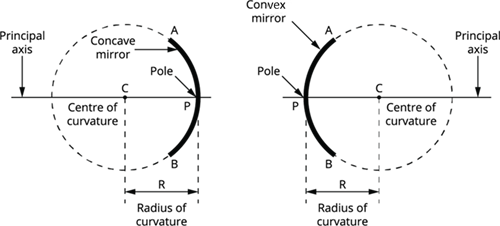
Terms of spherical mirrors
Image formation by a concave mirror:
| Object position | Image position | Nature and size |
| At infinity | At \(F\) | Real, inverted and highly diminished |
| Beyond \(C\) | Between \(F\) and \(C\) | Real, inverted and diminished |
| At \(C\) | At \(C\) | Real, inverted and same size |
| Between \(C\) and \(F\) | Beyond \(C\) | Real, inverted and enlarged |
| At \(F\) | At infinity | Image would not be formed |
| Between \(P\) and \(F\) | Behind the mirror | Virtual, erect and enlarged |
Image formation by a convex mirror:
| Object position | Image position | Nature and size |
| At infinity | At \(F\), behind the mirror | Virtual, erect, highly diminished and point-sized |
| Between infinity and \(P\) |
Between \(P\) and \(F\), behind the mirror
|
Virtual, erect and diminished |
Sign convention:
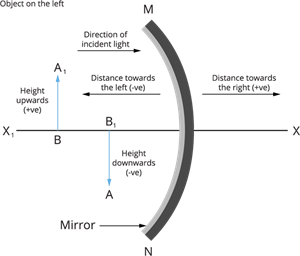
Sign convention in mirror
Laws of refraction:
Refraction is the bending of light when it travels from one medium to another due to change in speed.
i. The incident ray, the refracted ray and the normal ray to the interface of two transparent media at the point of incidence all lie in the same plane.
ii. The ratio of the sine of the angle of incidence to the sine of the angle of refraction is a constant for the light of a given colour and the given pair of media. This law is also known as Snell’s law of refraction. (This is true for angle \(0\) < \(i\) < \(90^{\circ}\))
\(\frac{sin i}{sin r}\ =\ constant\)
\(\frac{sin i}{sin r}\ =\ \frac{\mu_2}{\mu_1}\ =\ \frac{v_1}{v_2}\)
Refractive index:
\(n\ =\ \frac{c}{v}\)
Refraction through rectangular glass slab:
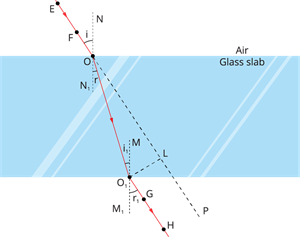
Refraction through a rectangular glass slab
- Light bends twice (entry and exit)
- Emergent ray is parallel to incident ray
- Only lateral displacement occurs
Image formation by a convex lens:
| Object position | Image position | Nature and size |
| At infinity | At \(F_2\) | Real, inverted and highly diminished |
| Beyond \(2F_1\) | Between \(F_2\) and \(2F_2\) | Real, inverted and diminished |
| At \(2F_1\) | At \(2F_2\) | Real, inverted and same size |
| Between \(F_1\) and \(2F_1\) | Beyond \(2F_2\) | Real, inverted and enlarged |
| At \(F_1\) | At infinity | Image would not be formed |
| Between \(F_1\) and \(O\) | On the same side of the lens as the object | Virtual, erect and enlarged |
Image formation by a concave lens:
| Object position | Image position | Nature and size |
| At infinity | At \(F_1\) | Virtual, erect, highly diminished and point-sized |
| Between infinity and \(O\) |
Between \(F_1\) and \(O\)
|
Virtual, erect and diminished |
Formulae:
| Mirror or lens | Formula | Magnification |
| Mirror | \(\frac{1}{f}\ =\ \frac{1}{v}\ +\ \frac{1}{u}\) | \(m\ =\ \frac{-v}{u}\ =\ \frac{h_i}{h_o}\) |
| Lens | \(\frac{1}{f}\ =\ \frac{1}{v}\ -\ \frac{1}{u}\) | \(m\ =\ \frac{v}{u}\ =\ \frac{h_i}{h_o}\) |
Relation between \(R\) and \(f\) of mirror:
\(R\ = 2f\)
Power of lens:
\(P\ =\ \frac{1}{f}\)
Unit of power is dioptre (\(D\)) or (\(m^{-1}\))