

Refraction:
Refraction occurs when light travels from one transparent medium to another at a different speed.
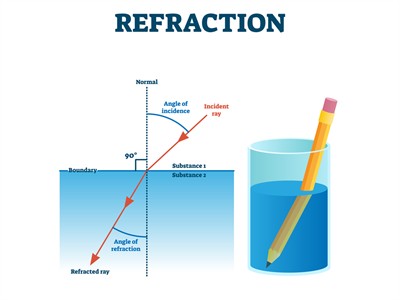
Consider the case of a pencil that appears to be displaced while partially submerged in water. The light that reaches you from the part of the submerged pencil appears to come from a different direction than the light that reaches you from the part of the pencil above water. The pencil appears to be displaced at the interface as a result of this.
Light travels in the same direction unless it enters another medium obliquely, according to these findings. When light travels obliquely from one medium to another, its direction of propagation changes due to a change in speed. This phenomenon is known as the refraction of light.
The following are the laws of refraction of light.
- The incident ray, the refracted ray and the normal to the interface of two transparent media at the point of incidence all lie in the same plane.
- The ratio of the sine of the angle of incidence to the sine of the angle of refraction is a constant for the light of a given colour and the given pair of media. This law is also known as Snell’s law of refraction. (This is true for angle \(0^°<i<90^°\))
If \(i\) is the angle of incidence and \(r\) is the angle of refraction, then
\(\frac{sin\ i}{sin\ r}\ =\ constant\)
Refraction through a glass slab:
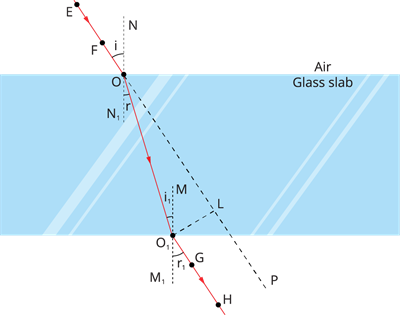
The term refractive index can be used to express the magnitude of the change in direction that occurs in a given pair of media. The relative speed of light propagation in different media can be linked to the refractive index, an important physical quantity. Light propagates at different speeds in different media, as it turns out.
The absolute refractive index of a medium is the ratio of the speed of light in vacuum (or air) to the speed of light in that medium.
The refractive index of water is \(n_w\ =\ 1.33\).
This means that the ratio of light speed in air to light speed in water is equal to \(1.33\). This means light travels \(1.33\) times faster in air than in water.
Similarly, crown glass has a refractive index of \(n_g\ =\ 1.52\).