

Refraction is the bending of light when it passes from one medium to another due to a change in its speed. Light travels in a straight line in a uniform medium, but changes direction at the boundary between two media with different optical densities.
Laws of refraction:
1. The incident ray, refracted ray of light, and the normal to the interface of two transparent surfaces (media) at the point of incidence all lie on the same plane.
2. This law states that the ratio of the sine of the angle of incidence and sine of the angle of refraction is equal to the reciprocal of the ratio of refractive indices of the two transparent media. This law is also known as Snell’s law.
Rectangular glass slab:
A rectangular glass slab is a transparent glass block with parallel opposite faces.
When light passes through it, refraction happens twice:
When light passes through it, refraction happens twice:
- Once when entering the slab
- Once when leaving the slab
Refraction in glass slab:
From air to glass: Ray bends towards the normal
From glass to air: Ray bends away from the normal
Flowchart of refraction in rectangular glass slab:
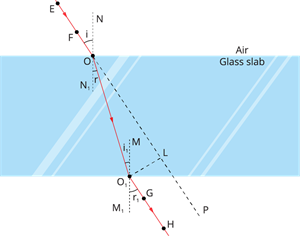
Refraction of light through a rectangular glass slab
Incident ray (\(EF\)) strikes at \(O\)
\(\downarrow\)
Angle of incidence (\(i\)) formed between \(EF\) and normal (\(NN_1\))
\(\downarrow\)
Refracted ray bends towards normal (\(NN_1\))
\(\downarrow\)
Angle of refraction (\(r\)) formed between ray and normal (\(NN_1\))
\(\downarrow\)
Ray reaches second surface at \(O_1\)
\(\downarrow\)
Angle of incidence inside slab (\(i_1\)) formed between ray and normal (\(MM_1\))
\(\downarrow\)
Emergent ray (\(GH\)) comes out through \(O_1\) and bends away from normal
\(\downarrow\)
Emergent ray (\(GH\)) parallel to incident ray (\(EF\))
\(\downarrow\)
Dashed line (\(OL\)) shows original path of incident ray
\(\downarrow\)
Distance between (\(OL\)) and emergent ray is the lateral displacement
Emergent ray:
The emergent ray is the ray that comes out of the second surface of the glass slab.
Lateral displacement:
Lateral displacement is the perpendicular distance between the original path of the incident ray and the path of the emergent ray.
The emergent ray is parallel but shifted sideways. No lateral displacement occurs if the light is incident normally (angle of incidence \(=\ 0^{\circ}\)).
Factors affecting lateral displacement:
- Thickness of slab: More thickness = more shift
- Angle of incidence: Larger angle = more shift
- Refractive index: Denser medium = more shift
- Colour of light: Violet = more shift, Red = less shift