

Refraction is the bending of light when it passes from one medium to another due to a change in its speed.
Snell’s law:
Snell’s Law explains how light bends when it passes from one medium to another.
\(\frac{sin\ i}{sin\ r}\ =\ \frac{n_2}{n_1}\)
Refractive index:
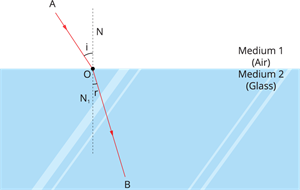
Two media with interface
Let \(v_1\) be the light speed in medium \(1\) and \(v_2\) be the light speed in medium \(2\).
The ratio of the speed of light in medium \(1\) to the speed of light in medium \(2\) gives the refractive index of medium \(2\) compared to medium \(1\). The symbol \(n_{21}\) is commonly used to represent it. This can be expressed mathematically as,
\(n_{21}\ =\ \frac{\text{Speed of light in medium 1}}{\text{Speed of light in medium 2}}\ =\ \frac{v_1}{v_2}\)
By the same argument, the refractive index of medium \(1\) with respect to medium \(2\) is represented as \(n_{12}\). It is given by
\(n_{12}\ =\ \frac{\text{Speed of light in medium 2}}{\text{Speed of light in medium 1}}\ =\ \frac{v_2}{v_1}\)
Absolute refractive index:
The absolute refractive index of a medium is the ratio of the speed of light in vacuum (\(c\)) to the speed of light in that medium (\(v\)).
\(n\ =\ \frac{c}{v}\)
It is always greater than or equal to \(1\). A higher refractive index means the medium is optically denser.
Speed vs Refractive index vs Optical density:
| Speed of light (\(v\)) | Refractive index (\(n\)) | Optical density |
| Speed at which light travels in a medium | Ratio of speed of light in vacuum to that in the medium | Ability of a medium to slow down light |
| \(v\ =\ \frac{c}{n}\) | \(n\ =\ \frac{c}{v}\) | No fixed formula (depends on refractive index) |
| Inversely proportional to refractive index | Inversely proportional to speed of light | Directly proportional to refractive index |
| Higher value \(\rightarrow\) light travels faster | Higher value \(\rightarrow\) light slows more | Higher value \(\rightarrow\) medium is optically denser |
| Lower value \(\rightarrow\) light travels slower | Lower value \(\rightarrow\) light slows less | Lower value \(\rightarrow\) medium is optically rarer |
| Higher speed \(\rightarrow\) less bending of light | Higher n \(\rightarrow\) more bending of light | Higher optical density \(\rightarrow\) more bending of light |
| Example: Air (high speed) | Example: Diamond (high refractive index) | Example: Diamond (optically denser than air) |
Key link:
- Speed \(\uparrow\ \rightarrow\) Refractive Index \(\downarrow\ \rightarrow\) Optical Density \(\downarrow\)
- Speed \(\downarrow\ \rightarrow\) Refractive Index \(\uparrow\ \rightarrow\) Optical Density \(\uparrow\)