

The chapter on light reflection and refraction is assigned a weightage of \(7\) or \(8\) marks, highlighting its significance in the overall curriculum. Understanding this chapter will enhance to know behaviour of light and using ray diagrams to illustrate concepts and explain real-life applications of optics.
Also to prepare effectively for related exam questions. It is essential to grasp the concepts of reflection & refraction and image formation by mirrors. Focusing on these concepts will greatly benefit both academic performance and practical application in physics.
In the below, we have provided the details of the question distribution among the different sections.
- Section A (\(1 \)mark) - One question
- Section B (\(2\) mark) - One question
- Section D or E (4 or 5 mark) - One question
Learning outcomes:
- Introduction to light: Understanding the nature and properties of light.
- Laws of reflection and refraction: Applying the laws of reflection and refraction to practical situations.
- Analyzing image formation in mirrors using ray diagrams: Outline the rule of image formation by spherical mirrors in order to complete the ray diagrams by drawing reflected rays.
Light appears to travel in straight-lines when we observe common optical phenomena around us. The fact that a small light source casts a sharp shadow on an opaque object indicates that light travels in a straight line, commonly referred to as a ray of light.
The majority of the light falling on a highly polished surface, such as a mirror, is reflected. The reflected ray obeys the laws of reflection.
The laws of reflection:
(i) The angle of incidence is equal to the angle of reflection, and
(ii) The incident ray, the normal to the mirror at the point of incidence and the reflected ray all lie in the same plane.
The plane mirror has a following property,
- It produces a virtual and erect image.
- The image has the same dimensions as the object.
- The formed image is the same distance behind the mirror as the object in front of it.
- The image is inverted laterally.
A spherical mirror's reflecting surface can be curved inwards or outwards.
concave mirror - reflecting surface that is curved inwards.
convex mirror - curved reflecting surface that faces outwards.
There are two types image formed in the mirror,
Real image - The image is obtained on the screen
Virtual image - The image can not be obtained on the screen
Terms related to spherical mirrors:
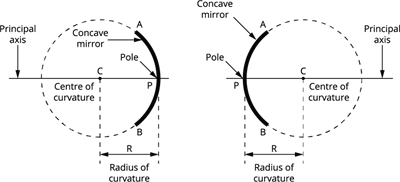
Terms related to spherical mirror
Aperture: The portion available for reflection is called aperture; APB is is the aperture.
Pole: It is the geometric centre of the reflecting surface. It is denoted by P.
Centre of Curvature: It is the centre of the sphere of which the mirror forms a part. C is the centre of curvature.
Principal Axis: It is a straight line passing through the centre of curvature and the pole. The line passing through P and C in the figure is the principal axis.
Radius of Curvature (R): It is the radius of the sphere of which the mirror forms a part. PC is the radius of curvature.
Principal Focus: Consider a parallel beam of light incident on a spherical mirror, In the case of a concave mirror, the parallel beam after reflection converges at a point F which is called the principal focus.
Focal Length: It is the distance between the pole and the principal focus. PF is the focal length. It is denoted by ‘ f ’. It is measured in m or cm.
concave mirror - converging mirror
convex mirror - diverging mirror
The radius of curvature of small aperture spherical mirrors is found to be equal to twice the focal length,
\(R\ =\ 2f\)
This indicates that the principal focus of a spherical mirror lies midway between the pole and centre of curvature.