

Electromagnetism is the branch of science that explains the relationship between electricity and magnetism. In this session, we will understand electromagnetism, magnetic fields, and magnetic field lines through simple activities.
Activity: To demonstrate that a current-carrying conductor produces a magnetic field and causes the deflection of a compass needle.
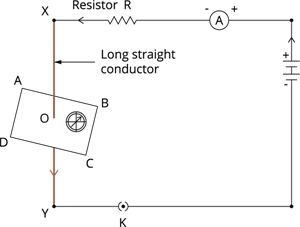
A current-carrying copper wire
Step 1: Connect a thick straight copper wire between points \(X\) and \(Y\) in an electric circuit as shown in the figure. Keep the wire perpendicular to the plane of the paper.
Step 2: Place a small compass horizontally near the copper wire.
Step 3: Observe and note the initial position of the compass needle.
Step 4: Close the circuit by inserting the plug key so that electric current flows through the wire.
Step 5: Observe the position of the compass needle again and compare the position of the needle before and after the current is switched on.
Observation:
- Before the current is passed, the compass needle points in the north-south direction.
- When electric current flows through the copper wire, the compass needle gets deflected from its original position.
Conclusion:
The deflection of the compass needle shows that a current-carrying conductor produces a magnetic field around it. Hence, electric current has a magnetic effect, proving that electricity and magnetism are closely related.
Hans Christian Oersted and the discovery of electromagnetism:
Hans Christian Oersted, a renowned \(19\)th-century physicist, made a landmark discovery in \(1820\) when he observed that a compass needle was deflected by a nearby current-carrying wire. This accidental observation revealed, for the first time, that electricity and magnetism are closely related.
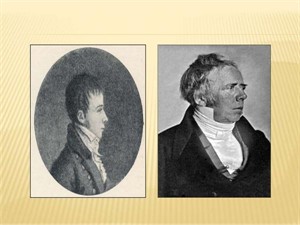
Hans Christian Oersted
Oersted's discovery laid the foundation for the field of electromagnetism and paved the way for the development of many modern technologies, including radio, television, and fibre-optic communication. In recognition of his significant contribution, the oersted (\(Oe\)), a unit of magnetic field strength, was named in his honour.
Activity: To find the magnetic field pattern around a bar magnet.
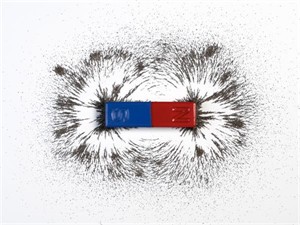
Magnetic field pattern around a bar magnet
Step 1: Fix a white sheet of paper on a drawing board using adhesive tape or pins.
Step 2: Place a bar magnet at the centre of the paper.
Step 3: Sprinkle iron filings uniformly over the paper using a salt sprinkler.
Step 4: Gently tap the drawing board to allow the iron filings to arrange themselves.
Step 5: Observe the pattern formed by the iron filings around the bar magnet.
Observation:
- The iron filings arrange themselves in a definite curved pattern around the bar magnet.
- The filings are crowded near the two poles of the magnet and are farther apart away from the poles.
- The pattern formed represents the magnetic field around the bar magnet.
Conclusion:
When iron filings are sprinkled around a bar magnet, each filing becomes temporarily magnetised due to the magnetic field. As a result, the filings align themselves along the direction of the magnetic field, forming a pattern that represents the magnetic field lines around the magnet.
Magnetic field:
A magnetic field is the region surrounding a magnet in which its magnetic force can be detected.
Magnetic field lines are imaginary lines used to represent the direction and strength of a magnetic field. They show the path along which a free north pole would move in the magnetic field.
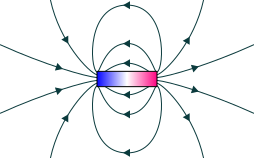
- Magnetic field lines are continuous closed curves.
- Outside a magnet, they emerge from the north pole and terminate at the south pole.
- Inside the magnet, they travel from the south pole to the north pole.
- The direction of the magnetic field at any point is the direction in which the north pole of a compass needle points.
- The magnetic field is stronger where the field lines are closer together (near the poles of the magnet).
- The magnetic field is weaker where the field lines are farther apart.
- No two magnetic field lines intersect each other, because if they did, the magnetic field would have two directions at the same point, which is impossible.