

Force on a current-carrying conductor in a magnetic field:
An electric current flowing through a conductor produces a magnetic field around it. This magnetic field can exert a force on a nearby magnet. The French scientist Andre Marie Ampere proposed that the magnet also exerts an equal and opposite force on the current-carrying conductor.
Activity: To demonstrate that a current-carrying conductor placed in a magnetic field experiences a force and to study the effect of changing the direction of current and magnetic field.
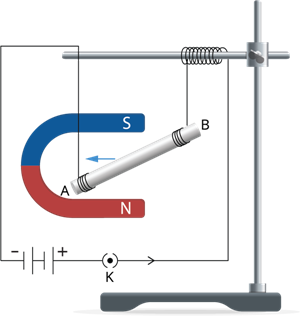
A current-carrying rod
Step 1: Suspend a small aluminium rod \(AB\) horizontally using two connecting wires from a stand.
Step 2: Place a strong horseshoe magnet such that the rod lies between its poles and the magnetic field is directed upwards.
Step 3: Connect the aluminium rod in series with a battery, key and rheostat.
Step 4: Pass current through the rod from end \(B\) to end \(A\) and observe the movement of the rod.
Step 5: Reverse the direction of current through the rod and observe the change in its movement.
Step 6: Interchange the poles of the magnet to reverse the direction of the magnetic field and observe the movement of the rod again.
Observation:
- When current flows through the rod, the aluminium rod gets displaced towards the left.
- When the direction of current is reversed, the rod moves towards the right.
- When the direction of the magnetic field is reversed, the direction of displacement of the rod also reverses.
Conclusion:
A current-carrying conductor placed in a magnetic field experiences a force. The direction of force depends on the direction of current and the direction of the magnetic field. The force is maximum when the current and magnetic field are perpendicular to each other.
Fleming's Left-Hand Rule:
The direction of force can be determined using Fleming’s Left-Hand Rule.
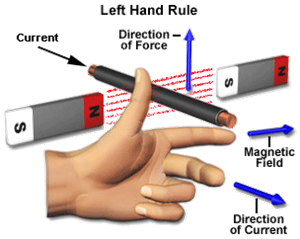
Fleming's Left Hand Rule
According to Fleming’s Left-Hand Rule, stretch the thumb, forefinger and middle finger of the left hand mutually perpendicular. If the forefinger points in the direction of the magnetic field and the middle finger points in the direction of current, then the thumb gives the direction of force or motion of the conductor.
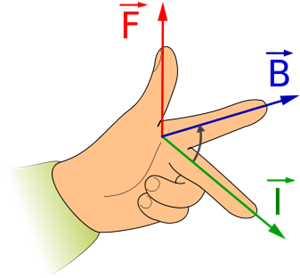
Fleming's Left Hand Rule
This principle is used in devices such as electric motors, generators, loudspeakers and measuring instruments.
Domestic electric circuits:
Electric power is supplied to our homes through the mains supply using three wires: live or positive wire (red insulation), neutral or negative wire (black insulation) and earth wire (green insulation).
The live wire carries current to appliances, while the neutral wire returns current to the source. The potential difference between them is \(220\ V\).
High-power appliances such as geysers and air coolers use a \(15\ A\) circuit, while low-power appliances such as bulbs and fans use a \(5\ A\) circuit.
Electrical appliances are connected in parallel so that each appliance receives the same voltage and can be operated independently.
Earth wire:
The earth wire wire, which has insulation of green colour, is usually connected to a metal plate deep in the earth near the house. It is a safety wire connected to the metallic body of appliances. It provides a low-resistance path for leakage current and prevents electric shocks.
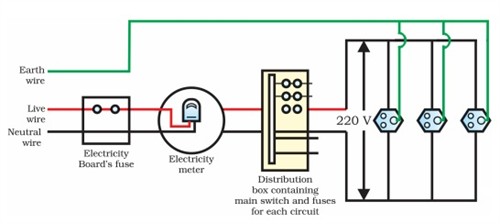
Common domestic circuits
Current rating:
The current rating is the maximum current that a fuse will carry for an indefinite period without the fuse element's deterioration.
\(Current\ rating\ =\ \frac{Power}{Voltage}\ \times\ 1.25\)
Electric fuse and safety measures:
A fuse is a safety device used to protect electrical circuits and appliances from excessive current.
Overloading occurs when the current exceeds the safe limit due to connecting too many appliances or a sudden rise in supply voltage.
Short-circuiting occurs when the live and neutral wires come into direct contact due to damaged insulation or faults. This causes a sudden increase in current. The heat produced melts the fuse wire, breaking the circuit and preventing damage.
Magnetism in medicine:
Electric currents produced by nerve cells in the human body create weak magnetic fields. These fields, especially from the heart and brain, are used in Magnetic Resonance Imaging (MRI) to obtain images of body parts. MRI helps doctors in the diagnosis of various medical conditions.
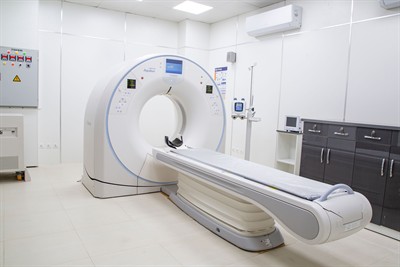
An MRI machine