

A current-carrying straight conductor produces a magnetic field around it when electric current flows through it. The magnetic field forms concentric circles around the conductor, and its direction depends on the direction of the current.
Direction of the magnetic field around a current-carrying straight conductor:
When electric current flows through a straight conductor, it produces a magnetic field around the conductor. The direction of this magnetic field can be determined using a compass placed near the wire.
If the current flows from north to south, the north pole of the compass needle deflects towards the east. When the direction of current is reversed from south to north, the compass needle deflects towards the west. This shows that reversing the direction of electric current also reverses the direction of the magnetic field around the conductor.
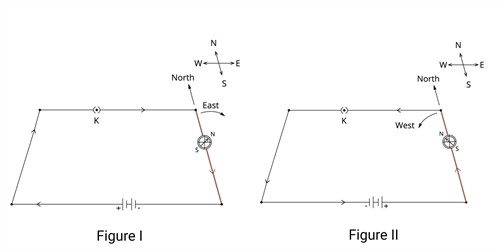
Electric circuits with straight copper wires placed parallel to and over a compass needles
Activity:
To observe the magnetic field produced around a current-carrying straight conductor and study the direction of the magnetic field using a compass.
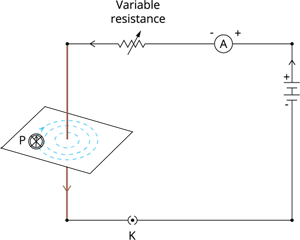
A current-carrying straight conductor
Step 1: Insert the thick straight copper wire vertically through the centre of a rectangular cardboard and fix it firmly.
Step 2: Connect the copper wire in series with the battery, rheostat, ammeter, and plug key.
Step 3: Sprinkle iron filings uniformly over the cardboard.
Step 4: Set the rheostat to a fixed position and note the current shown by the ammeter.Close the plug key to allow current to flow through the wire.
Step 5: Gently tap the cardboard so that the iron filings can arrange themselves.
Step 6: Observe the pattern formed by the iron filings around the wire.
Step 7: Place a compass at different points around the wire to determine the direction of the magnetic field.
Step 8: Reverse the direction of current and observe the change in the compass needle.
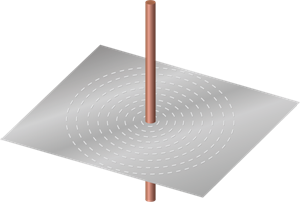
Concentric circles pattern
Observation:
The iron filings arrange themselves in the form of concentric circles around the current-carrying straight wire. The compass needle points along the direction of the magnetic field lines. When the direction of current is reversed, the direction of the magnetic field also reverses.
Conclusion:
A current-carrying straight conductor produces a magnetic field around it. The magnetic field lines are concentric circles centred on the conductor, and their direction depends on the direction of the electric current.
Factors affecting the magnetic field around a current-carrying straight conductor:
The strength of the magnetic field around a current-carrying straight conductor depends on two main factors:
Magnitude of Current: As the current flowing through the conductor increases, the magnetic field around it becomes stronger. This is observed by the greater deflection of the compass needle placed near the conductor.
Distance from the Conductor: The magnetic field is strongest near the conductor and decreases as the distance from the conductor increases. A compass placed farther away shows a smaller deflection, indicating a weaker magnetic field. Thus, the magnetic field strength decreases with increasing distance from the conductor.
Right-Hand Thumb Rule:
The Right-Hand Thumb Rule is used to determine the direction of the magnetic field around a current-carrying straight conductor.
If the conductor is held in the right hand with the thumb pointing in the direction of the current, the curled fingers indicate the direction of the magnetic field lines around the conductor.
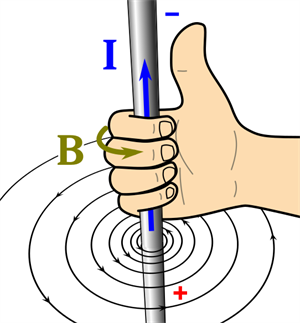
Right-Hand Thumb Rule
Maxwell's Corkscrew Rule:
The Right-Hand Thumb Rule is also known as Maxwell's Corkscrew Rule. Imagine driving a corkscrew in the direction of the electric current. The direction in which the corkscrew rotates represents the direction of the magnetic field around the conductor.
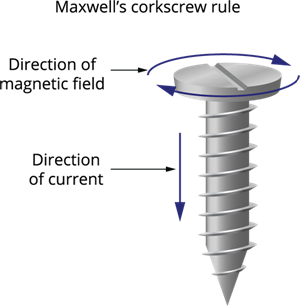
Maxwell's Corkscrew Rule
Summary:
Factors:
| Straight conductor | Magnetic field strength |
| Current | \(B\ \propto\ I\) |
| Distance | \(B\ \propto\ \frac{1}{d}\) |
Right-Hand Thumb Rule:
| Direction of current flow | Direction of magnetic field |
| Downwards (Top to Bottom) | Clockwise |
| Upwards (Bottom to Top) | Anticlockwise |