

The chapter on human eye and the colourful world is assigned a weightage of \(3\ or\ 4\) marks, highlighting its significance in the overall curriculum.
It is essential to grasp the concepts of parts and functions of the human eye, defects of vision and their correction, atmospheric refraction, dispersion, and scattering of light. Focusing on these concepts will greatly benefit both academic performance and practical application in physics.
Below, we have provided the details of the question distribution among the different sections.
- \(1\) mark - One question
- \(2\ or\ 3\) marks - One question
Learning outcomes:
- Analyse the refraction of light through a prism: Examine the path of light rays through a prism how the light gets deviated when traveling through a prism.
- Colour perception: Understand how colours are perceived through the combination of different wavelengths of light.
- Visual phenomena: Explain various visual phenomena, such as the formation of rainbows and the appearance of the colour of the sky
Refraction through a glass prism:
A glass prism is a transparent optical device with triangular surfaces. It is used to refract and disperse light.
Path of light in a prism:
Light enters the prism and bends towards the normal. It travels inside the prism. When it emerges, it bends away from the normal.
Angle of deviation:
The angle between the direction of the incident ray and emergent ray is called the angle of deviation.
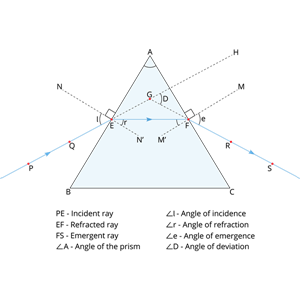
Refraction in prism
Dispersion of light through a prism:
White light from the Sun is made up of different colours. When this white light passes through a glass prism, it splits into its constituent colours and forms a band of colours on a screen. This phenomenon is called dispersion of light.
- The band of colours obtained is called a spectrum, which consists of Violet, Indigo, Blue, Green, Yellow, Orange, and Red (VIBGYOR).
- Each colour bends by a different amount while passing through the prism, causing separation of colours.
- Violet light bends the most, while red light bends the least.
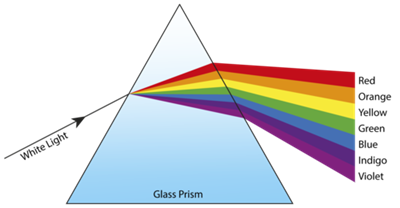
Dispersion of light through a prism
PYQ - Dispersion of light
Newton’s experiment on dispersion of light:
White light is made up of seven colours. When it passes through a glass prism, each colour bends by a different amount. Red light bends the least and violet bends the most, causing the colours to separate and form a spectrum. Isaac Newton first demonstrated this using a prism. He also used a second inverted prism to recombine the spectrum back into white light, proving that sunlight contains seven colours.
Rainbow formation:
A rainbow is a natural spectrum formed in the sky after rain. Tiny water droplets act like small prisms. When sunlight enters a droplet, it is refracted, internally reflected, and refracted again as it comes out. This process splits white light into different colours. A rainbow is always seen in the direction opposite to the Sun.
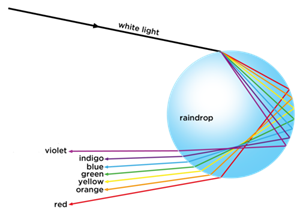
Rainbow formation
Sequence of processes:
- Refraction – Sunlight enters the water droplet and bends.
- Dispersion – White light splits into different colours inside the droplet.
- Internal Reflection – The light reflects inside the droplet.
- Refraction (again) – Light comes out of the droplet, further separating colours.
PYQ - Rainbow formation
Atmospheric refraction:
- The Earth’s atmosphere consists of several layers.
- The air near the surface is denser, while at higher altitudes it becomes rarer.
- When light travels from one layer to another, its speed changes, causing it to bend continuously.
- This continuous bending of light is called atmospheric refraction.
- Since atmospheric conditions (temperature, pressure, density) keep changing, the bending of light is also not uniform, leading to visual effects like twinkling of stars and apparent shift in position of objects.
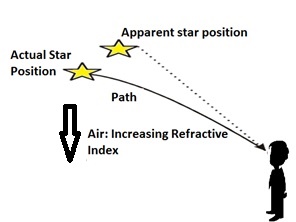
Apparent star position due to atmospheric refraction
Key points:
- Refraction occurs due to variation in refractive index of air.
- Atmosphere acts like a series of refracting layers.
- Causes apparent displacement of objects.
Why don't the planets twinkle?
- The planets are greatly closer to the earth and are thus viewed as extended sources.
- Let's consider a planet as a group of large number of point-sized sources of light.
- The total variation in the amount of light piercing our eye from all the respective point-sized sources will equate out to zero, thereby nullifying the twinkling effect.
Advanced sunrise and delayed sunset:
- The Sun is visible before actual sunrise and after actual sunset due to atmospheric refraction.
- When the Sun is slightly below the horizon, its light rays travel through denser layers of the atmosphere and bend towards the normal.
- This bending makes the Sun appear higher than its actual position.
- The Sun appears to rise about \(2\ minutes\) earlier (advanced sunrise).
- The Sun appears to set about \(2\ minutes\) later (delayed sunset)
- Thus, the total day duration increases by about \(4\ minutes\).
- The apparent flattening of the Sun’s disc at sunrise and sunset is also due to the same phenomenon.
Illustration:
- Actual position of Sun \(\rightarrow\) below horizon
- Apparent position \(\rightarrow\) above horizon
- Caused by bending of light towards denser layers.
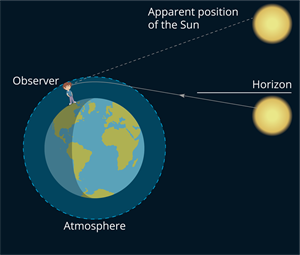
Atmospheric refraction effects at sunrise and sunset
Scattering of light:
Tyndall effect:
- The Tyndall effect is the scattering of light by colloidal particles, making the path of light visible.
- Colloidal particles (like dust, smoke, or water droplets) are large enough to scatter light.
- When light falls on them, they absorb some energy then scatter light in different directions.
- This makes the beam of light visible
Important point:
- True solutions \(\rightarrow\) no visible path
- Colloids \(\rightarrow\) visible path (due to scattering)
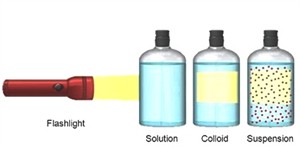
Tyndall effect
Colour of the Sun at sunrise and sunset:
- The Sun appears reddish at sunrise and sunset.
- At sunrise and sunset, sunlight travels a longer distance through the atmosphere.
- During this long path: Shorter wavelengths (blue, violet) are scattered away.
- Only longer wavelengths (red, orange) reach our eyes.
- Hence, the Sun appears reddish.
Key idea:
- Scattering \(\propto\ shorter\ wavelength\)
- Red light \(\rightarrow\) least scattered \(\rightarrow\) reaches observer
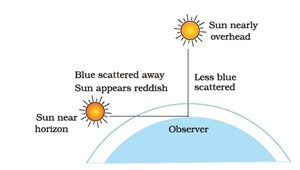
Reddening of the Sun at sunrise and sunset
Why is the Sky Blue?
- The sky appears blue due to scattering of light by atmospheric particles.
- When sunlight enters the atmosphere, it interacts with tiny air molecules and dust particles.
- Shorter wavelengths (blue and violet) are scattered more.
- Since our eyes are more sensitive to blue light and violet is mostly absorbed, the scattered blue light reaches our eyes, making the sky appear blue.
Important notes:
- Scattering depends on wavelength
- Smaller particles \(\rightarrow\) scatter shorter wavelengths more
- In space \(\rightarrow\) no scattering \(\rightarrow\) sky appears black