

Atmospheric refraction:
Atmospheric refraction is the bending of light as it passes through the Earth’s atmosphere due to variations in air density, temperature, and refractive index at different heights.
- The Earth’s atmosphere consists of several layers.
- The air near the surface is denser, while at higher altitudes it becomes rarer.
- When light travels from one layer to another, its speed changes, causing it to bend continuously.
- This continuous bending of light is called atmospheric refraction.
- Since atmospheric conditions (temperature, pressure, density) keep changing, the bending of light is also not uniform, leading to visual effects like twinkling of stars and apparent shift in position of objects.
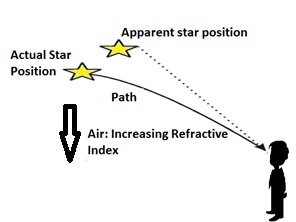
Apparent star position due to atmospheric refraction
Key points:
- Refraction occurs due to variation in refractive index of air.
- Atmosphere acts like a series of refracting layers.
- Causes apparent displacement of objects.
Why don't the planets twinkle?
- The planets are greatly closer to the earth and are thus viewed as extended sources.
- Let's consider a planet as a group of large number of point-sized sources of light.
- The total variation in the amount of light piercing our eye from all the respective point-sized sources will equate out to zero, thereby nullifying the twinkling effect.
Advanced sunrise and delayed sunset:
- The Sun is visible before actual sunrise and after actual sunset due to atmospheric refraction.
- When the Sun is slightly below the horizon, its light rays travel through denser layers of the atmosphere and bend towards the normal.
- This bending makes the Sun appear higher than its actual position.
- The Sun appears to rise about \(2\ minutes\) earlier (advanced sunrise).
- The Sun appears to set about \(2\ minutes\) later (delayed sunset)
- Thus, the total day duration increases by about \(4\ minutes\).
Illustration:
- Actual position of Sun \(\rightarrow\) below horizon
- Apparent position \(\rightarrow\) above horizon
- Caused by bending of light towards denser layers.
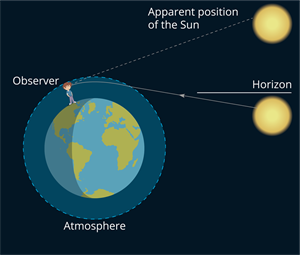
Atmospheric refraction effects at sunrise and sunset
Tyndall effect:
- The Tyndall effect is the scattering of light by colloidal particles, making the path of light visible.
- Colloidal particles (like dust, smoke, or water droplets) are large enough to scatter light.
- When light falls on them, they absorb some energy then scatter light in different directions.
- This makes the beam of light visible.
Example:
Sunlight entering a dusty room through a small hole
Light passing through a forest canopy with mist
Car headlights visible in fog
Projector beam visible in a dark cinema hall
Important point:
- True solutions \(\rightarrow\) no visible path
- Colloids \(\rightarrow\) visible path (due to scattering)
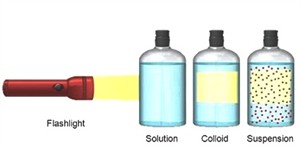
Tyndall effect
Colour of the Sun at sunrise and sunset:
- The Sun appears reddish at sunrise and sunset.
- At sunrise and sunset, sunlight travels a longer distance through the atmosphere.
- During this long path: Shorter wavelengths (blue, violet) are scattered away.
- Only longer wavelengths (red, orange) reach our eyes.
- Hence, the Sun appears reddish.
Key idea:
- Scattering \(\propto\ shorter\ wavelength\)
- Red light \(\rightarrow\) least scattered \(\rightarrow\) reaches observer
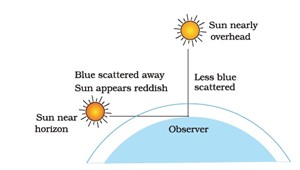
Reddening of the Sun at sunrise and sunset
Why is the Sky Blue?
- The sky appears blue due to scattering of light by atmospheric particles.
- When sunlight enters the atmosphere, it interacts with tiny air molecules and dust particles.
- Shorter wavelengths (blue and violet) are scattered more.
- Since our eyes are more sensitive to blue light and violet is mostly absorbed, the scattered blue light reaches our eyes, making the sky appear blue.
Important notes:
- Scattering depends on wavelength
- Smaller particles \(\rightarrow\) scatter shorter wavelengths more
- In space \(\rightarrow\) no scattering \(\rightarrow\) sky appears black