

Scattering of light:
Scattering of light is the phenomenon in which light rays are deviated or spread in different directions when they interact with particles present in a medium such as air, dust, or water droplets.
- It occurs due to the interaction of light with small particles, causing the light to change its direction.
- Scattering depends on factors like the size of particles and the wavelength (colour) of light.
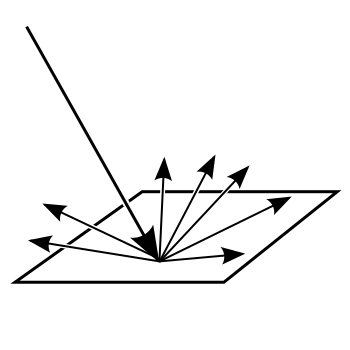
Scattering process
Types of scattering:
1. Rayleigh scattering:
- Scattering of light by very small particles (like gas molecules in the atmosphere).
- According to Rayleigh scattering law, scattering is inversely proportional to the fourth power of wavelength:
\(S\ \propto\ \frac{1}{\lambda^{4}}\)
- So, shorter wavelengths (blue light) scatter more than longer wavelengths (red light).
- This is why the sky appears blue and the Sun looks red at sunrise and sunset.
2. Mie scattering:
- Occurs when particle size is equal to or larger than the wavelength of light.
- Caused by dust, smoke, and water droplets.
- Responsible for the white colour of clouds.
3. Tyndall Effect: (Tyndall Scattering)
- Scattering of light by colloidal particles.
- Makes the path of light visible (e.g., sunlight in a dusty room).
- Seen in substances like milk, smoke, and muddy water.
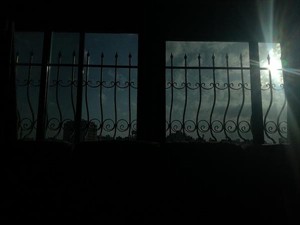
Sunlight entering through a window
4. Raman Scattering: (Raman Effect)
- Scattering in which the wavelength of light changes after interaction with matter.
- Produces new frequencies called Raman lines (Stokes and Anti-Stokes lines).
- Used in advanced scientific studies.
Dispersion of light through a prism:
White light from the Sun is made up of different colours. When this white light passes through a glass prism, it splits into its constituent colours and forms a band of colours on a screen. This phenomenon is called dispersion of light.
- The band of colours obtained is called a spectrum, which consists of Violet, Indigo, Blue, Green, Yellow, Orange, and Red (VIBGYOR).
- Each colour bends by a different amount while passing through the prism, causing separation of colours.
- Violet light bends the most, while red light bends the least.
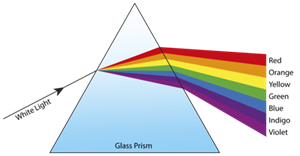
Dispersion of light through a prism
Thus, dispersion occurs because different colours of light travel at different speeds in a prism, leading to the formation of a spectrum.
Newton’s experiment on dispersion of light:
White light is made up of seven colours. When it passes through a glass prism, each colour bends by a different amount. Red light bends the least and violet bends the most, causing the colours to separate and form a spectrum. Isaac Newton first demonstrated this using a prism. He also used a second inverted prism to recombine the spectrum back into white light, proving that sunlight contains seven colours.
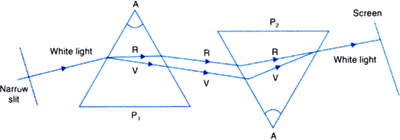
Recombination of the spectrum of white light
Rainbow formation:
A rainbow is a natural spectrum formed in the sky after rain. Tiny water droplets act like small prisms. When sunlight enters a droplet, it is refracted, internally reflected, and refracted again as it comes out. This process splits white light into different colours. A rainbow is always seen in the direction opposite to the Sun.
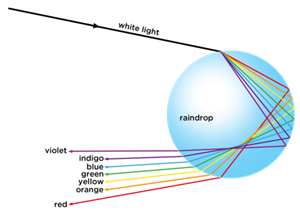
Rainbow formation
Sequence of processes:
- Refraction – Sunlight enters the water droplet and bends.
- Dispersion – White light splits into different colours inside the droplet.
- Internal Reflection – The light reflects inside the droplet.
- Refraction (again) – Light comes out of the droplet, further separating colours.
These processes together produce a rainbow, seen in the sequence VIBGYOR.
Reference:
https://tuitionphysics.com/2016-feb/the-physics-behind-rainbow-formation/