

The human eye is an important sense organ that enables us to see objects and colours around us. It works by allowing light to enter the eye and form an image on the retina. The eye can adjust its focal length to see both near and distant objects. Sometimes, defects in vision such as myopia, hypermetropia, and presbyopia may occur, which can be corrected using suitable lenses.
Structure of the eye:
The eyeball has a diameter of about \(2.3\ cm\) and is roughly spherical in shape.

Structure of the eye
Important parts of the human eye:
Cornea:
It is the thin and transparent layer at the front surface of the eye. It allows light to enter the eye and performs most of the refraction (bending) of light rays.
Iris:
It is the coloured portion of the eye located behind the cornea. It controls the size of the pupil.
Pupil:
It is the small opening in the centre of the iris. It controls and regulates the amount of light that enters the eye.
Retina:
The retina is a delicate, light-sensitive membrane at the back of the eye. It forms a real and inverted image of the object and contains cells that detect light.
Eye Lens:
The eye lens is a transparent convex lens. It helps focus light and makes fine adjustments in focal length.
Ciliary muscles:
They are muscles attached to the eye lens. They help change the shape and thickness of the lens to adjust its focal length.
Power of accomodation:
The power of the eye's accommodation is the capability of the eye lens to focus nearby and distant objects. This is attained by modifying the focal length of the eye lens with the help of ciliary muscles.
Difference between near and distant vision:
| Near vision | Distant vision |
| Ciliary muscles contract | Ciliary muscles relax |
| Eye lens becomes thicker | Eye lens becomes thinner |
| Focal length decreases | Focal length increases |
| Helps to focus nearby objects on the retina | Helps to focus distant objects on the retina |
| The near point is the least distance of distinct vision | The far point is the maximum distance of clear vision |
| For a normal human eye, near point is \(25\ cm\) | For a normal human eye, far point is infinity |
Difference between eye defects:
| Myopia | Hypermetropia | Presbyopia |
| Near-sightedness | Far-sightedness | Old age hypermetropia |
| The far point is moved nearer | The nearer point is moved farther | Decreased power of accommodation (aging) |
| Lengthening of the eyeball | Shortening of the eyeball | Weakening of ciliary muscles |
| Focal length becomes smaller | Focal length becomes longer | Loss of flexibility of eye lens |
| Image is formed in front of retina | Image is formed behind retina | Near point moves farther |
| Corrected by concave lens | Corrected by convex lens | Corrected by bifocal lens |
| Negative power lens | Positive power lens |
Concave on upper for distant vision
Convex on lower for near vision
|
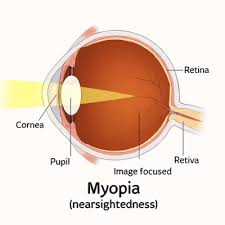 Myopia
|
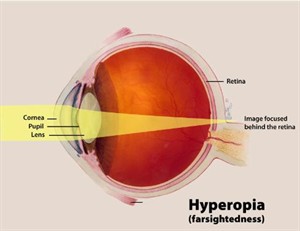 Hypermetropia
|
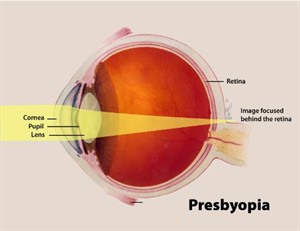 Presbyopia
|
Reference:
https://agarwals-219c6.kxcdn.com/wp-content/uploads/2025/08/blog1-400x400.png