

Structure of the eye:
The eyeball has a diameter of about \(2.3\ cm\) and is roughly spherical in shape.

Structure of the eye
Important parts of the human eye:
| Part | Important function |
| Cornea | Allows light to enter the eye and performs most of the refraction of light. |
|
Iris
|
Controls the size of the pupil. |
| Pupil | Regulates the amount of light entering the eye. |
| Retina | Forms a real and inverted image and contains light-sensitive cells. |
| Eye lens | Focuses light on the retina and makes fine adjustments in focal length. |
| Ciliary muscles | Change the shape and thickness of the lens to adjust its focal length. |
Power of accomodation:
The power of the eye's accommodation is the capability of the eye lens to focus nearby and distant objects. This is attained by modifying the focal length of the eye lens with the help of ciliary muscles.
Difference between near and distant vision:
| Near vision | Distant vision |
| Ciliary muscles contract | Ciliary muscles relax |
| Eye lens becomes thicker | Eye lens becomes thinner |
| Focal length decreases | Focal length increases |
| Helps to focus nearby objects on the retina | Helps to focus distant objects on the retina |
| The near point is the least distance of distinct vision | The far point is the maximum distance of clear vision |
| For a normal human eye, near point is \(25\ cm\) | For a normal human eye, far point is infinity |
Difference between eye defects:
| Myopia | Hypermetropia | Presbyopia |
| Near-sightedness | Far-sightedness | Old age hypermetropia |
| The far point is moved nearer | The nearer point is moved farther | Decreased power of accommodation (aging) |
| Lengthening of the eyeball | Shortening of the eyeball | Weakening of ciliary muscles |
| Focal length becomes smaller | Focal length becomes longer | Loss of flexibility of eye lens |
| Image is formed in front of retina | Image is formed behind retina | Near point moves farther |
| Corrected by concave lens | Corrected by convex lens | Corrected by bifocal lens |
| Negative power lens | Positive power lens |
Concave on upper for distant vision
Convex on lower for near vision
|
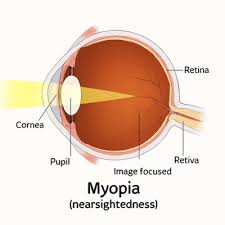 Myopia
|
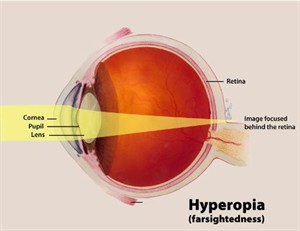 Hypermetropia
|
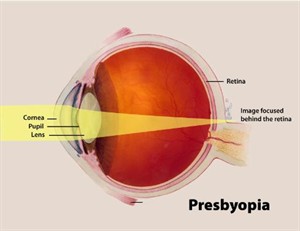 Presbyopia
|
Refraction thorough glass slab and prism:
| Glass slab | Prism |
| Opposite faces are parallel | Faces are not parallel |
| Emergent ray is parallel to incident ray | Emergent ray is deviated |
| Only lateral displacement occurs | Deviation and dispersion occur |
| No splitting of white light | Splits white light into colours |
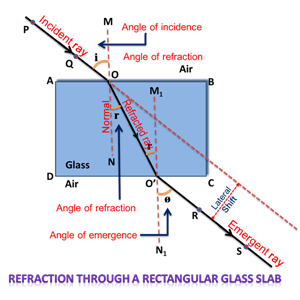 A rectangular glass slab
|
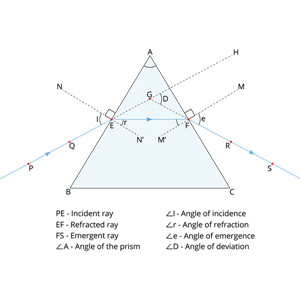 A glass prism
|
Dispersion, Scattering and atmospheric refraction:
| Dispersion | Scattering | Atmospheric refraction |
| Splitting of white light into its component colours. | Redirection of light in different directions when it interacts with particles of a medium. | Bending of light as it passes through different layers of the atmosphere having different refractive indices. |
| Different colours of light bend through different angles when passing through a prism. | Light interacts with small particles such as air molecules, dust, smoke or water droplets. | Different atmospheric layers have different temperatures, densities and refractive indices. |
| Different wavelengths are refracted by different amounts. | Shorter wavelengths are scattered more strongly by very fine particles. | The changing refractive conditions of the atmosphere affect the path of light. |
| White sunlight passing through a prism produces VIBGYOR. | Fine atmospheric particles scatter blue light more strongly, making the sky appear blue. | Stars appear to twinkle. Because the apparent position and brightness of stars changes. |
| Helps explain the formation of a rainbow. | Red light is scattered less by fog and smoke, so danger signals are red. Produces the Tyndall effect when light is scattered by colloidal particles. |
The Sun appears about \(2\) minutes before actual sunrise. The Sun remains visible for about \(2\) minutes after actual sunset.
|
| Splitting | Spreading | Bending |
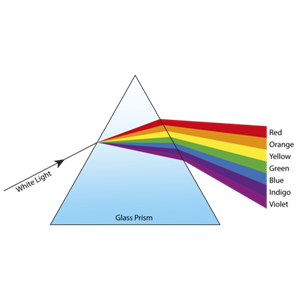 Dispersion of white light by glass prism
|
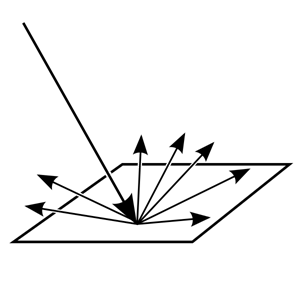 Scattering of light
|
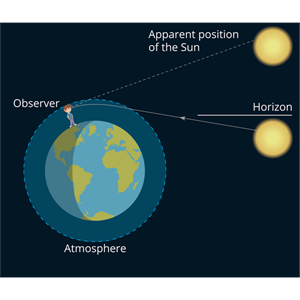 Atmospheric refraction effects on sun
|
Sequence of processes in rainbow formation:
- Refraction – Sunlight enters the water droplet and bends.
- Dispersion – White light splits into different colours inside the droplet.
- Internal Reflection – The light reflects inside the droplet.
- Refraction (again) – Light comes out of the droplet, further separating colours.
These processes together produce a rainbow, seen in the sequence VIBGYOR.
Reference:
https://agarwals-219c6.kxcdn.com/wp-content/uploads/2025/08/blog1-400x400.png