

Refraction is the bending of light when it passes from one medium to another due to a change in its speed. Light travels in a straight line in a uniform medium, but changes direction at the boundary between two media with different optical densities.
Laws of refraction:
1. The incident ray, refracted ray of light, and the normal to the interface of two transparent surfaces (media) at the point of incidence all lie on the same plane.
2. This law states that the ratio of the sine of the angle of incidence and sine of the angle of refraction is equal to the reciprocal of the ratio of refractive indices of the two transparent media. This law is also known as Snell’s law.
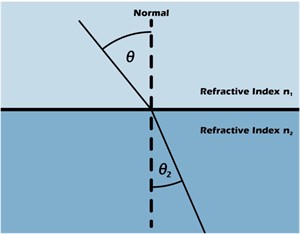
Refractive indices of two media
Snell’s law:
\(\frac{sin\ i}{sin\ r}\ =\ \frac{n_2}{n_1}\)
\(n_1\), \(n_2\) = refractive indices of the first and second medium
\(i\) = angle of incidence
\(r\) = angle of refraction
Absolute refractive index:
The absolute refractive index of a medium is the ratio of the speed of light in vacuum (\(c\)) to the speed of light in that medium (\(v\))
\(n\ =\ \frac{c}{v}\)
It is always greater than or equal to \(1\). A higher refractive index means the medium is optically denser.
Change in speed of light:
When light enters a denser medium from a rarer one:
-
Its speed decreases.
-
It bends towards the normal.
When it enters a rarer medium from a denser one:
-
Its speed increases.
-
It bends away from the normal.
Dispersion:
Dispersion is the splitting of white light into its constituent colors when passing through a prism.
- Different colors have different wavelengths, so they travel at slightly different speeds in the medium.
- Violet bends the most; red bends the least.
- This is why a rainbow forms from sunlight in raindrops.
The relationship between the speed of light (\(c\)), wavelength (\(\lambda\)), and frequency (\(f\)) of light is:
\(c\ =\ f\ \lambda\)
Light slows down in denser media, but its frequency stays the same; only wavelength changes.
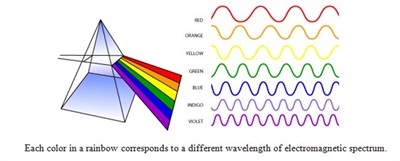
Variation of wavelength of visible light
Scattering:
Scattering is the phenomenon in which light is deflected in different directions by small particles in a medium.
- Responsible for the blue color of the sky (shorter wavelength blue light scatters more).
- Red sunsets occur because longer red wavelengths scatter less and reach our eyes.
The relationship between wavelength and scattering is explained by Rayleigh scattering
\(I\ \propto\ \frac{1}{\lambda^{4}}\)
\(I\) is the intensity of scattered light.
\(\lambda\) is the wavelength of light.