

Refraction of light:
Refraction is the bending of light when it passes from one medium to another. It occurs because the speed of light changes in different media.
1. Refraction through a rectangular glass slab:
Consider a glass slab, a substance or sheet made of glass material with three dimensions: length, breadth, and height, and it is in cuboidal shape.
Glass slab does not deviate, nor does it disperse the light rays whenever passing through it.
What happens when light passes through a glass slab:
When light enters the glass slab from air, it bends towards the normal. Inside the slab, the light travels in a straight line. When the light exits the slab, it bends away from the normal.
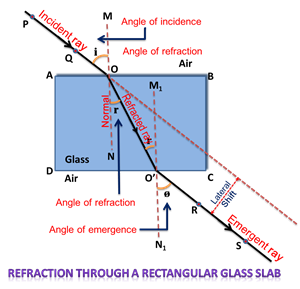
Refraction of light through a rectangular glass slab
Important rays:
Incident ray – ray falling on the surface
Refracted ray – ray inside the glass slab
Emergent ray – ray coming out of the slab
Key observation:
The emergent ray is parallel to the incident ray. This happens because the two faces of the glass slab are parallel. The bending at the two surfaces is equal and opposite.
Lateral displacement:
The sideways shift of the emergent ray from the incident ray is called lateral displacement. Even though the ray is parallel, it is shifted slightly to one side.
Special case:
If light falls along the normal, it passes straight without bending.
2. Refraction through a glass prism:
A glass prism is a transparent optical device with triangular surfaces. It is used to refract and disperse light.
Path of light in a prism:
Light enters the prism and bends towards the normal. It travels inside the prism. When it emerges, it bends away from the normal.
Angle of deviation:
The angle between the direction of the incident ray and emergent ray is called the angle of deviation.
Dispersion of light:
When white light passes through a prism, it splits into seven colours. This phenomenon is called dispersion of light. The colours appear in the order VIBGYOR.
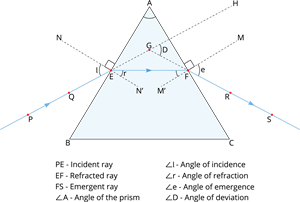
Refraction of light through a glass prism
\(PE\) is the incident ray, \(EF\)is the refracted ray, and \(FS\) is the emergent ray.
\(\angle i\) \(-\) \(Angle\ of\ incidence\)
\(\angle r\) \(-\) \(Angle\ of\ refraction\)
\(\angle e\) \(-\) \(Angle\ of\ emergence\)
\(\angle D\) \(-\) \(Angle\ of\ deviation\)
Difference between glass slab and prism:
| Glass slab | Prism |
| Opposite faces are parallel | Faces are not parallel |
| Emergent ray is parallel to incident ray | Emergent ray is deviated |
| Only lateral displacement occurs | Deviation and dispersion occur |
| No splitting of white light | Splits white light into colours |