

By the end of this session, students should:
- Understand electricity using prior knowledge of force, motion, and work.
- Clearly relate current, voltage, resistance, and magnetism to mechanical concepts.
- Recognise electricity as motion and interaction of charges governed by familiar laws.
- Apply Newton’s laws reasoning to electrical and magnetic phenomena.
1. Motion and cause of motion: (Class 9 Force and motion to Class 10 Electric current)
Class 9 Concept: Force produces motion
Motion of an object changes only when a force is applied. According to Newton’s second law, force causes acceleration.
\(F\)\(=\)\(m\)\(a\)
Without force, motion does not change.

Motion of a bus
Class 10 Concept: Electric current
Electric current is the rate of flow of electric charge in a conductor.
\(I\)\(=\)\(Q\)\(/\)\(t\)
Here \(I\) is the current measured in \(ampere\) (\(A\)); \(Q\) is the charge measured in \(coulomb\) (\(C\)) and \(t\) is the time measured in \(second\) (\(s\)).
Charges remain stationary unless a potential difference is applied.
Potential difference plays a role similar to force; it causes charges to move.
Current indicates how fast charges are moving through a conductor.
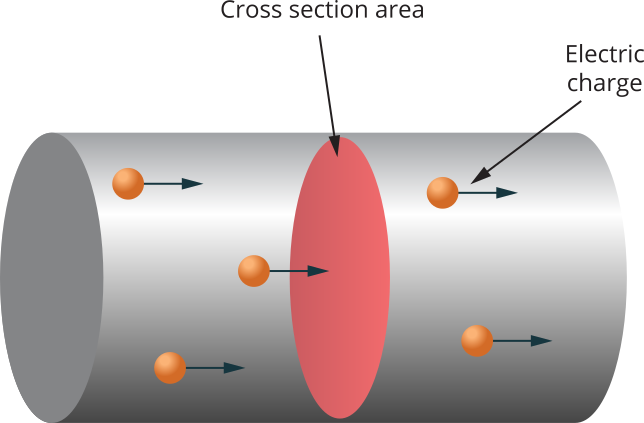
Flow of charges in a conductor
Integrated explanation:
- Just as force causes motion of objects, voltage causes motion of charges.
- Electric current is nothing but motion, but instead of mass, it is charge that moves.
- Electric current is simply motion studied at the microscopic level.
2. Work and energy transfer: (Class 9 Work to Class 10 Potential difference)
Class 9 Concept: Work done by force
Work is done when a force causes displacement. Work represents transfer of energy.
\(W\)\(=\)\(F\)\(\times\)\(d\)
Energy is supplied to move an object through a distance.

Work done in moving a box
Class 10 Concept: Potential difference
Potential difference is defined as the work done per unit charge.
Here \(V\) is the potential measured in \(volt\) (\(V\)); \(W\) is the work done measured in \(joule\) (\(J\)) and \(Q\) is the charge measured in \(coulomb\) (\(C\)).
It tells how much electrical energy is supplied to move charges.
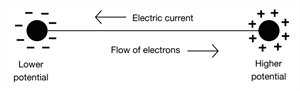
Work done in moving a charge
Integrated explanation:
- In mechanics, force does work to move mass.
- In electricity, voltage does work to move charge.
- Both describe energy transfer, only the agent of motion changes.
3. Resistance to motion: (Class 9 Inertia to Class 10 Resistance)
Class 9 Concept: Inertia
Inertia is the resistance of a body to any change in its state of motion.
Greater mass means greater inertia.
Inertia opposes acceleration even when a force is applied.
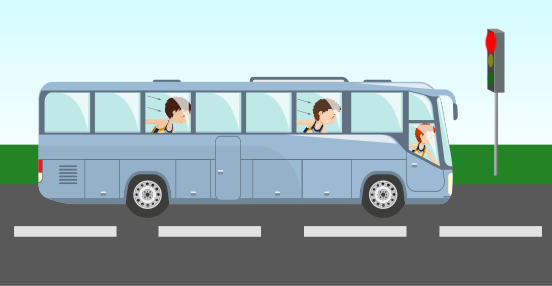
Inertia of motion
Class 10 Concept: Resistance
Resistance is the opposition offered by a conductor to the flow of current.
Materials with higher resistance allow less current to flow.
Resistance depends on material, length, area, and temperature.
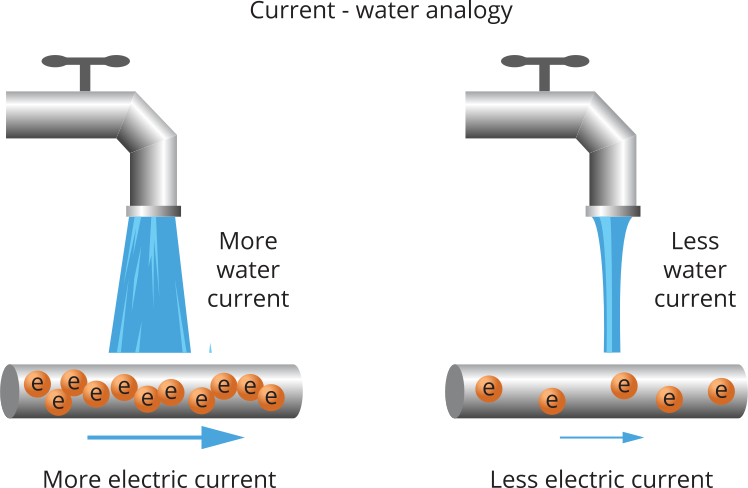
Current resistance
Integrated explanation:
- Inertia resists the motion of mass.
- Resistance resists the motion of charge.
- Both act as opposition to motion, one mechanical and one electrical.
4. Laws governing motion: (Class 9 Newton’s second law to Class 10 Ohm’s law)
Class 9 Concept: Newton’s second law
Acceleration is directly proportional to force and inversely proportional to mass.
\(F\)\(=\)\(m\)\(a\)
Force is the cause; acceleration is the effect.
This law explains predictable motion.
Class 10 Concept: Ohm’s law
Current is directly proportional to voltage, provided conditions (temperature) remain constant.
\(V\)\(=\)\(I\)\(R\)
Here \(V\) is the potential measured in \(volt\) (\(V\)); \(I\) is the current measured in \(ampere\) (\(A\)) and \(R\) is the resistance measured in \(ohm\) (\(\Omega\))
Voltage is the cause; current is the effect.
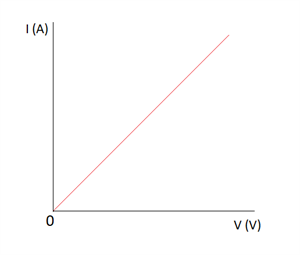
Relation between potential difference and current
Conceptual parallel:
| Motion (Class 9) | Electricity (Class 10) |
| Force (F) | Potential (V) |
| Acceleration (a) | Current (I) |
| Mass (m) | Resistance (R) |
Integrated explanation:
- Newton’s law explains how force produces motion.
- Ohm’s law explains how voltage produces current.
- Physics laws remain the same; only the quantities change.
5. Power: (Class 9 Mechanics to Class 10 Electricity)
Class 9 Concept: Power in work and energy
Power is defined as the rate of doing work.
It tells us how quickly work is done or energy is transferred.
\(P\)\(=\)\(W\)\(/\)\(t\)
Since work \(=\) force \(\times\) displacement
\(P\)\(=\)(\(F\)\(\times\)\(d\))\(/\)\(t\)
Because velocity \(=\) displacement \(/\) time
\(P\)\(=\)\(F\)\(v\)
The SI unit of power is \(watt\) (\(W\)).
Class 10 Concept: Power in electricity
Electric power is the rate at which electrical energy is consumed or supplied.
It indicates how fast an electrical appliance converts electrical energy into other forms.
Electric power \(=\) Electrical energy \(/\) time
\(W\)\(=\)\(V\)\(\times\)\(Q\)
Since \(I\)\(=\)\(Q\)\(/\)\(t\)
\(P\)\(=\)\(W\)\(/\)\(t\)
\(P\)\(=\)\(V\)\(\times\)\(I\)
Integrated explanation:
- Power always measures speed of energy transfer.
- Whether energy moves a body or flows through a wire, power tells us how fast it happens.
6. Magnetic effects of motion: (Class 9 Force to Class 10 Magnetic force)
Class 9 Concept: Force changes motion
Force can change speed, direction, or shape. Forces may act by contact or from a distance.
Class 10 Concept: Magnetic force on current
A current-carrying conductor experiences force in a magnetic field.
This force can cause motion of the conductor.
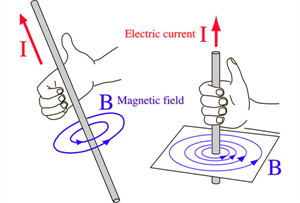
Magnetic field around a current carrying conductor
Integrated explanation:
- In mechanics, force acts on objects.
- In electricity, magnetic force acts on moving charges.
- Motion remains central; only the nature of force changes.
7. Energy conversion: (Class 9 Work and energy to Class 10 Motor and generator)
Class 9 Concept: Energy conversion
Machines convert energy from one form to another. Mechanical work can produce useful energy.
Class 10 Concept: Electric motor and generator
Motor: Electrical energy to mechanical energy.
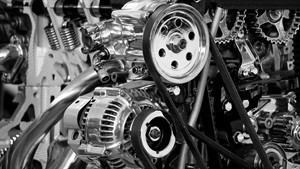
Electric motor
Generator: Mechanical energy to electrical energy.
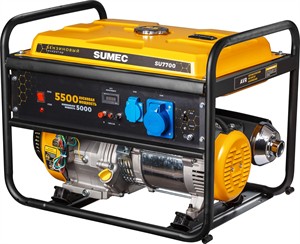
Electric generator
Integrated explanation:
- The same laws of energy conservation apply everywhere.
- Electric machines are simply mechanical principles powered by electricity.
Important!
Force causes motion; voltage causes current.
Inertia resists motion; resistance resists current.
Work transfers energy; potential difference supplies electrical energy.
Motion of charges produces magnetism; Changing magnetic fields produce current.
Physics is not a collection of chapters, it is one continuous story.
Once you understand motion, energy, and force, electricity becomes a familiar story; not a new chapter, but the next page of the same book.
Physics becomes meaningful when you see one law explaining many phenomena.