

By the end of this session, students should:
- Understand light using Class 9 knowledge of sound and waves.
- Clearly explain reflection, refraction, and the human eye.
- See light as an extension of wave behaviour already studied.
-
Understand light as a wave phenomenon that follows predictable laws.
-
Appreciate how physics concepts are interconnected rather than isolated chapters.
1. Nature of light: (Class 9 Sound to Class 10 Light)
Class 9 Concept: Sound waves and energy
- Energy can travel in the form of waves.
- Sound is a mechanical wave that requires a medium and transfers energy from one point to another without transferring matter.
- Waves are characterized by frequency (f), time period (T), wavelength (\(\lambda\)), speed (v), and amplitude (A).
- Speed of sound in air is \(330\) - \(343\) \(m\)\(/\)\(s\)
| Wave characters | Frequency (f) | Time period (T) | Speed (v) |
| Unit | hertz (\(Hz\)) | second (\(s\)) | metre per second (\(m/s\)) |
| Formula | \({\text{Frequency}}\)\(=\)\(\frac{\text{Total number of oscillations}}{\text{Total time taken}}\) |
\({\text{Time period}}\)\(=\)\(\frac{1}{\text{Frequency}}\)
|
\({\text{Speed}}\)\(=\)\(\frac{\text{Distance}}{\text{Time taken}}\)
|
The relation between speed, wavelength, and frequency of a wave is
\(v\)\(=\)\(f\)\(\lambda\)

Sound waves
Class 10 Concept: Light as energy and waves
- Light is also a form of energy, but unlike sound, it does not require a material medium.
- Light travels as an electromagnetic wave and can pass through vacuum.
- Light energy travels in straight line paths called rays.
- When many rays travel together, they form a beam of light.
- Speed of light in air or vacuum is \(3\)\(\times\)\(10^{8}\) \(m\)\(/\)\(s\)
Integrated explanation:
- We already understand waves through sound.
- Light behaves similarly but is more energetic and faster.
- Sound helped us understand waves; light will help us understand vision.
2. Reflection of light: (Class 9 Sound to Class 10 Light)
Class 9 concept: Reflection of sound
- Sound waves bounce back from hard surfaces.
- This bouncing back is called reflection of sound.
- Echoes are produced when reflected sound reaches our ears after a short delay.
- Reflection follows definite rules.
- Reflection helps locate objects (e.g., bats, dolphins)
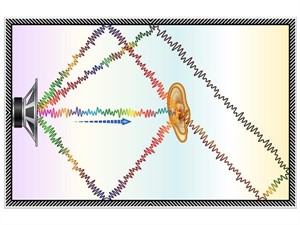
Reflection of sound wave
Laws of reflection of sound waves:
i. The incident sound wave, the reflected sound wave and the normal, all lie in the same plane.
ii. The angle of incident sound wave is equal to the angle of reflected sound wave ( \(\angle\)\(i\) \(=\) \(\angle\)\(r\) ).
Class 10 concept: Reflection of light
- Light also shows reflection.
- When light falls on a smooth, polished surface like a mirror, it bounces back.

Reflection of light rays
Laws of reflection of light:
i. The incident ray, the normal to the mirror at the point of incidence and the reflected ray all lie in the same plane.
ii. The angle of incidence is equal to the angle of reflection ( \(\angle\)\(i\) \(=\) \(\angle\)\(r\) ).
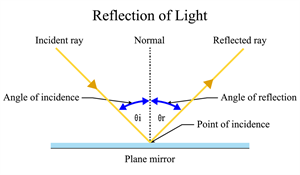
Ray diagram of light reflection
Integrated explanation:
- The laws governing reflection do not depend on whether the wave is sound or light.
- Reflection is a general wave property.
3. Cause–effect reasoning: (Class 9 Newton’s laws of motion to Class 10 Image formation by mirrors and lenses)
Class 9 Concept: Newton’s laws of motion
- Newton’s laws establish a clear cause–effect relationship between force and motion.
- When a force acts on an object, it causes a change in the object’s state of rest or motion.
- According to Newton’s second law, the magnitude of acceleration depends on the magnitude of the applied force and the mass of the object.
- Thus, a change in the force (cause) produces a change in the motion (effect ).
The second law of motion implies that the force (F) acting on an object is a product of its mass (m) and acceleration (a). The unit of force is newton (\(N\)).
\(F\) \(=\) \(m\)\(a\)
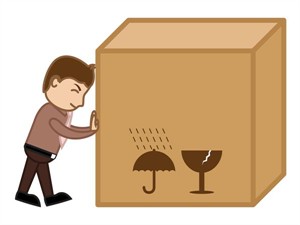
A boy trying to push a box by applying force
Class 10 Concept: Image formation by mirrors and lenses
- Image formation by mirrors and lenses also follows a cause–effect relationship.
- The position of the object with respect to the mirror or lens acts as the cause.
- Changing the object distance changes the way light rays reflect or refract.
- As a result, the nature of the image (real or virtual, erect or inverted), and size of image (magnified or diminished) changes in a predictable way.
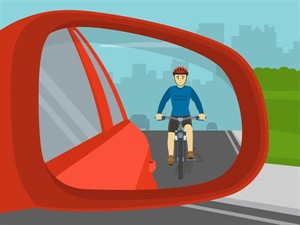
Rear view mirror
Integrated explanation:
In force and laws of motion, force is the cause and change in motion is the effect. In optics, object distance is the cause and image nature and position are the effects.
4. Energy conversion: (Class 9 Human ear to Class 10 Human eye)
Class 9 Concept: Human ear and energy conversion
- The human ear is a natural sound-receiving organ. Sound waves entering the ear cause the eardrum to vibrate.
- These vibrations are transmitted through the ossicles to the cochlea.
- In the cochlea, mechanical energy of sound vibrations is converted into electrical nerve signals, which are carried to the brain through the auditory nerve.
- This illustrates the concept of energy conversion, where energy changes from one form to another.
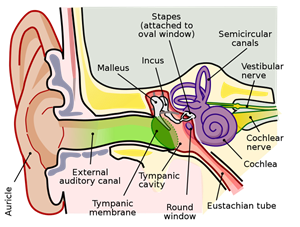
Structure of human ear
Class 10 Concept: Human eye and energy conversion
- The human eye is a natural light-receiving organ.
- Light rays entering the eye are refracted by the cornea and the eye lens to form an image on the retina.
- The retina converts light energy into electrical nerve signals, which are transmitted to the brain through the optic nerve.
- The eye functions as a biological optical instrument based on the laws of refraction.
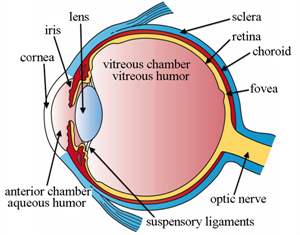
Structure of human ear
Integrated explanation:
- Both the human ear and the human eye demonstrate the principle of energy conversion.
- In the human ear: sound energy \(\rightarrow\) mechanical vibrations \(\rightarrow\) electrical signals.
- In the human eye: light energy \(\rightarrow\) electrical signals.
- Both organs act as biological transducers, converting wave energy from the environment into electrical signals that the brain interprets as sound or vision.
5. Dispersion of light: (Class 9 Sound frequency to Class 10 Light frequency)
| Aspect | Class 9 (Sound – Frequency) | Class 9 (Sound – Amplitude) | Class 10 (Light – Dispersion) | Class 10 (Light – Scattering) |
| Nature of waves | Mechanical waves | Mechanical waves | Electromagnetic waves | Electromagnetic waves |
| Composition | Sound consists of waves of different frequencies | Sound waves can have different amplitudes | White light consists of waves of different frequencies | Light waves have different wavelengths |
| Behaviour in a medium | Different sound frequencies behave differently | Different amplitudes produce different loudness | Different light frequencies bend by different amounts | Different wavelengths scatter by different amounts |
| Higher value effect | High frequency \(\rightarrow\) shrill sound | High amplitude \(\rightarrow\) loud sound | Violet light bends the most | Shorter wavelength (blue) scatters more |
| Lower value effect | Low frequency \(\rightarrow\) deep sound | Low amplitude \(\rightarrow\) soft sound | Red light bends the least | Longer wavelength (red) scatters less |
| Resulting effect | Change in pitch | Change in loudness | Separation of white light into colours (dispersion) | Blue sky and red sunrise or sunset (scattering) |
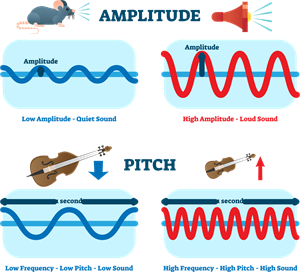
Variation of amplitude and pitch
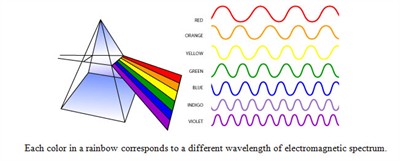
Variation of wavelength of visible light
Integrated explanation:
-
Frequency affects pitch (sound), colour (light), dispersion (bending), and scattering.
-
Amplitude affects loudness in sound; intensity in light.
- Imagine sound becoming colourful.
- Pitch becomes colour.
Example:
Synesthesia is a condition in which stimulation of one sense produces a response in another, such as perceiving sounds as colours.
Important!
Light behaves like waves, reflects like sound, bends like water waves, and allows us to see through the human eye.
Physics becomes meaningful when we realise that one idea explains many phenomena. When you understand this connection, learning becomes easier, deeper, and more enjoyable. Instead of separate chapters, you now see physics as a single, interconnected story; one that explains how we hear, how we see, and how the universe behaves.