

The chapter on Electricity is assigned a weightage of \(7\) marks, highlighting its significance in the overall curriculum. Understanding this chapter will enhance to know how basic electrical components connect and their function.
Also to prepare effectively for related exam questions. It is essential to grasp the various types of electrical circuits, components effects, and their applications. Focusing on these concepts will greatly benefit both academic performance and practical application in physics.
- Section A (\(1\) mark) - Two questions
- Section D (\(5 \)mark) - One question
Learning outcomes
-
Understanding Key Concepts: Grasp the basic principles of electric current, voltage, and resistance.
-
Applying Ohm’s Law: Use the relationship between voltage, current, and resistance to solve problems.
-
Analyzing Circuits: Distinguish between series and parallel circuits and analyze their behaviour.
-
Calculating Power and Energy: Compute electrical power and energy consumption in various circuits.
-
Heating effect of electric current: Understand the heating effect of electric current and its applications (e.g., electric heaters, fuse).
-
Mathematical Applications: Solve problems related to Ohm’s Law and circuit analysis.
Electric charge:
The origin of electricity lies in electric charges.
Electric charge is one of the basic fundamental properties of all matter, like mass and volume. Coulomb is the unit of measurement for electric charge, and it is denoted as 'C'.
Any charge (q) must be an integral multiple (n) of the fundamental unit of electron charge (e). Then, the formula is written as
\(q\ =\ ne\)
\(e\ =\ 1.6×10^{−19}\ C\)
Electricity is a branch of physics that deals with the flow of electric charges through a conductor. Electricity is classified into two parts. They are,
- Static electricity - deals with electric charges at rest
- Current electricity - deals with electric charges at motion
An electric current is generated by the motion of electric charges (electrons) through any conductor like copper wire. Electric current or simply current is denoted by the symbol 'I'. It is the total amount of charges flowing in a cross-section of a conductor in unit time.
\(I\ =\ \frac{q}{t}\), where q is the charge and t is time
Electric current is a scalar quantity. The SI unit of the electric current is ampere (A).
Conventionally, the electric current's direction is opposite to the direction of negative charges (electrons).
Electric potential
The electric potential at a point is defined as the amount of work done in moving a unit positive charge from infinity to that point against the electric force. It is measured in terms of volts (V).
The movement of the positive charges or protons constitutes the conventional current whereas, the movement of the negative charges or electrons constitutes the electron current.
Electric potential difference
The electric potential difference between two points is defined as the amount of work done in moving a unit positive charge from one point to another point against the electric force.
\(V\ =\ \frac{W}{q}\), where W is the work done and q is charge
Compennets of elctric circuit:
| Component | Working | Symbol |
| Battery | Two or more cells connected together | 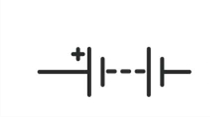 |
| Cell | converts chemical energy into electric energy | 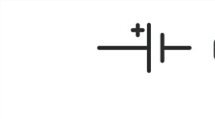 |
| Conducting wire | Pathway for electric current | 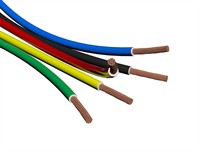 |
| Ammeter | To measure electric current |  |
| Voltmeter | To measure the potential |  |
| Resistor | Controlor regulate the current flow |  |
| Switch | stops or allows the current flow | |
| Rehostat | controls and selects the amount of current |  |
Ohm's law
At a constant temperature, the steady current 'I' flowing through a conductor is directly proportional to the potential difference 'V' between the two ends of the conductor.
\(R\ =\ \frac{V}{I}\), Where R is resistance, V is volt and I is current.
The SI unit of resistance is ohm \(\Omega\)
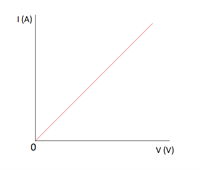
The relation between potential difference and current
Conductors - The materials which allow the electric current to pass through them.
Insulators - The materials which do not allow the electric current to pass through them.
The resistance of a material or a conductor depends on three factors. They are,
- Nature of conductor
- Length of conductor
- Area of a cross-section of the conductor
Exam questions:
Exam tips:
1. Formula
2. Hint words/Laws/Definition
3. Conversion of units
4. SI unit
5. Steps involved