

Kindly check out the below video to learn about the concept of Light reflection and refraction. Watch the video till the end to complete the task.
Light appears to travel in straight-lines when we observe common optical phenomena around us. The fact that a small light source casts a sharp shadow on an opaque object indicates that light travels in a straight line, commonly referred to as a ray of light.
The majority of the light falling on a highly polished surface, such as a mirror, is reflected. The reflected ray obeys the laws of reflection.
Let us recall these laws,
(i) The angle of incidence is equal to the angle of reflection, and
(ii) The incident ray, the normal to the mirror at the point of incidence and the reflected ray all lie in the same plane.
A spherical mirror's reflecting surface can be curved inwards or outwards.
A concave mirror is a spherical mirror with a reflecting surface that is curved inwards, facing the centre of the sphere. A convex mirror is a spherical mirror with a curved reflecting surface that faces outwards.
Terms related to spherical mirrors:
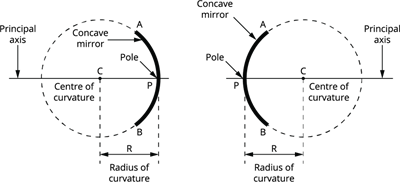
\(R = 2f\)
This indicates that the principal focus of a spherical mirror lies midway between the pole and centre of curvature.
Image formation by convex mirror:
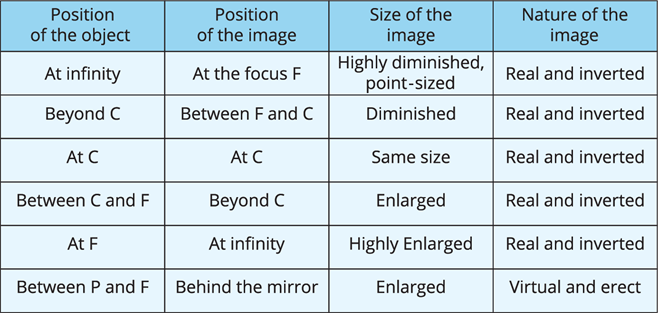
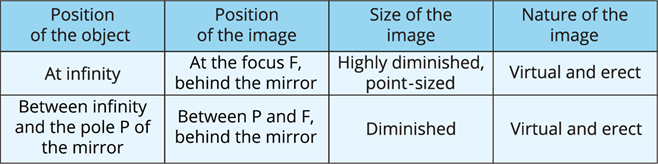
Image formation by convex mirror:
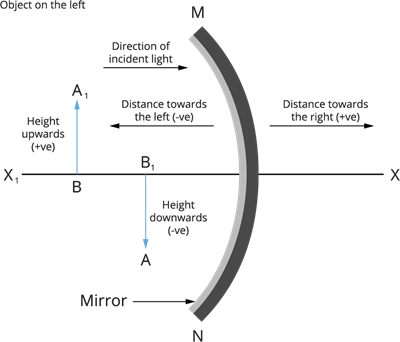
Sign convention:
The mirror formula, which is expressed as shows a relationship between these three quantities.
\(\frac{1}{f}\ =\ \frac{1}{u}\ +\ \frac{1}{v}\)
This formula holds true in all situations for all spherical mirrors and all object positions.
The magnification can be related to object distance (u) and the image distance (v).
\(m\ =\ \frac{-v}{u}\)
(or)
\(m\ =\ \frac{h'}{h_o}\) =\( \frac{-v}{u} \)
Refraction:
Refraction occurs when light travels from one transparent medium to another at a different speed.
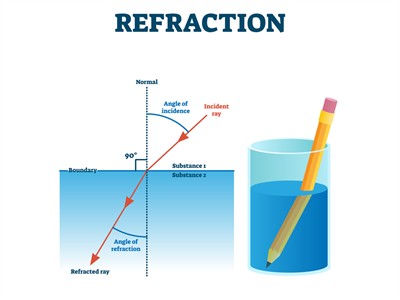
The following are the laws of refraction of light.
- The incident ray, the refracted ray and the normal ray to the interface of two transparent media at the point of incidence all lie in the same plane.
- The ratio of the sine of the angle of incidence to the sine of the angle of refraction is a constant for the light of a given colour and the given pair of media. This law is also known as Snell’s law of refraction. (This is true for angle 0°<i<90°)
If i is the angle of incidence and r is the angle of refraction, then
\(\frac{sin\ i}{sin\ r}\ =\ constant\)
Refraction through glass slab:
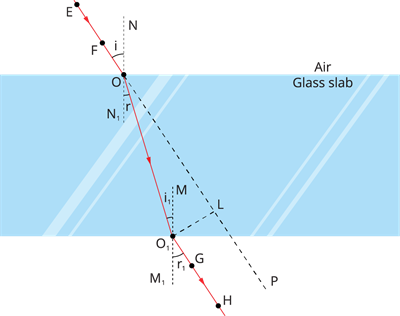
A medium's absolute refractive index is simply referred to as its refractive index.
The refractive index of water is \(n_w\ =\ 1.33\).
This means that the ratio of light speed in air to light speed in water is equal to \(1.33\).
Similarly, crown glass has a refractive index of \(n_g\ =\ 1.52\).
Lens:
A lens is formed by a transparent material bound by two surfaces, one or both of which are spherical. A lens is bound by at least one spherical surface in this case. Planes would be the other surface in such lenses.
A lens has two spherical surfaces, one convex and the other concave. Each of these surfaces is a sphere in its own right.
Image formation by convex lens:
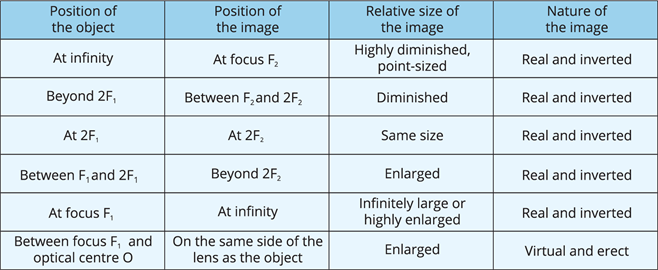
Image formation by concave lens:
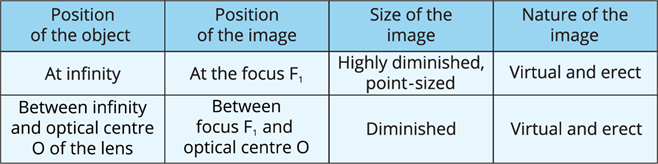
The lens equation is given by
\(\frac{1}{f}\ =\ \frac{1}{v}\ -\ \frac{1}{u}\)
The magnification is given by
\(M\ =\ \frac{v}{u}\ =\ \frac{h'}{h_o}\)
Power of a lens:
The power of a lens is the degree of convergence or divergence of light rays it achieves. A lens's power is equal to the reciprocal of its focal length. It is denoted by the letter P. The power P of a lens with a focal length of f is calculated as follows:
\(P\ =\ \frac{1}{f}\)
The 'dioptre' is the SI unit of lens power. The letter \(D\) stands for it. When f is measured in metres, power is measured in dioptres.
A lens with a focal length of one metre has a power of one dioptre.
The power of a convex lens is positive, while the power of a concave lens is negative.