

Kindly check out the below video to learn about the concept of Light reflection and refraction. Watch the video till the end to complete the task.
Refraction occurs when light travels from one transparent medium to another at a different speed.
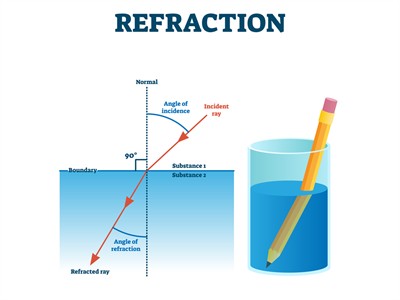
The following are the laws of refraction of light.
- The incident ray, the refracted ray and the normal ray to the interface of two transparent media at the point of incidence all lie in the same plane.
- The ratio of the sine of the angle of incidence to the sine of the angle of refraction is a constant for the light of a given colour and the given pair of media. This law is also known as Snell’s law of refraction. (This is true for angle \(0^°<i<90^°\))
If \(i\) is the angle of incidence and \(r\) is the angle of refraction, then
\(\frac{sin\ i}{sin\ r}\ =\ constant\)
Refraction through glass slab:
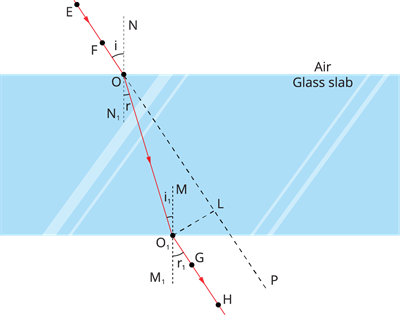
A medium's absolute refractive index is simply referred to as its refractive index.
The refractive index of water is \(n_w\ =\ 1.33\).
This means that the ratio of light speed in air to light speed in water is equal to \(1.33\).
Similarly, crown glass has a refractive index of \(n_g\ =\ 1.52\).
PYQ:
Exam tips:
1. Refractive index
2. Finding medium
3. Values to be notes
4. Formula
Lens:
A lens is formed by a transparent material bound by two surfaces, one or both of which are spherical. A lens has two spherical surfaces, one convex and the other concave. Each of these surfaces is a sphere in its own right.
Image formation by convex lens:
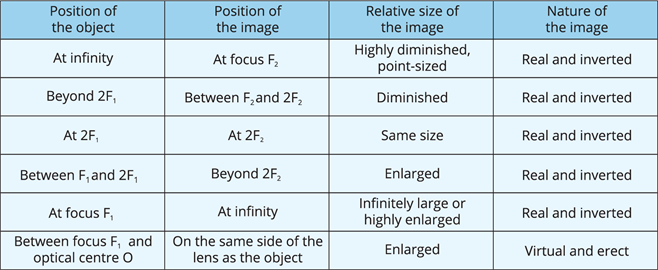
Image formation by concave lens:
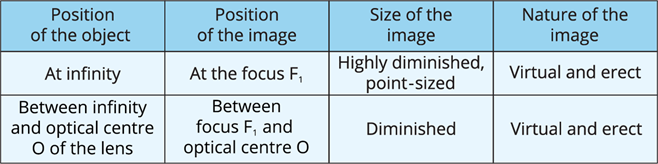
The lens equation is given by,
\(\frac{1}{f}\ =\ \frac{1}{v}\ -\ \frac{1}{u}\)
The magnification is given by,
\(M\ =\ \frac{v}{u}\ =\ \frac{h'}{h_o}\)
Power of a lens:
The power of a lens is the degree of convergence or divergence of light rays it achieves.
\(P\ =\ \frac{1}{f}\)
The 'dioptre' is the SI unit of lens power.
A lens with a focal length of one metre has a power of one dioptre.
The power of a convex lens is positive, while the power of a concave lens is negative.
PYQ:
Exam tips:
Exam tip:
1. Type of lens
2. Sign concention
3. Unit conversion
4. Magnification