

Answer the case-based question given below
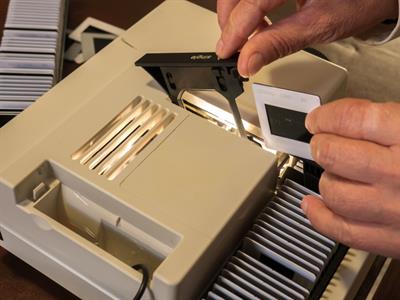
The above images are that of a specialised slide projector.
Slides are small transparencies mounted in sturdy frames ideally suited to magnification and projection, since they have a very high resolution and a high image quality. There is a tray where the slides are to be put into a particular orientation so that the viewers can see the enlarged erect images of the transparent slides. This means that the slides will have to be inserted upside down in the projector tray.
To show her students the images of insects that she investigated in the lab, Mrs. Iyer brought a slide projector. Her slide projector produced a \(500\) times enlarged and inverted image of a slide on a screen \(10\ m\) away.
Read the above passage carefully and give the answer of the following questions:
i. Based on the text and data given in the above paragraph, What kind of lens must the slide projector have?
ii. If \(v\) is the symbol used for image distance and \(u\) for object distance, then with one reason, state what will be the sign for \(\frac{v}{u}\) in the given case?
iii. A slide projector has a convex lens with a focal length of \(24\ cm\). The slide is placed upside down \(30\ cm\) from the lens. How far away should the screen be placed from the slide projector's lens so that the slide is in focus?
Slides are small transparencies mounted in sturdy frames ideally suited to magnification and projection, since they have a very high resolution and a high image quality. There is a tray where the slides are to be put into a particular orientation so that the viewers can see the enlarged erect images of the transparent slides. This means that the slides will have to be inserted upside down in the projector tray.
To show her students the images of insects that she investigated in the lab, Mrs. Iyer brought a slide projector. Her slide projector produced a \(500\) times enlarged and inverted image of a slide on a screen \(10\ m\) away.
Read the above passage carefully and give the answer of the following questions:
i. Based on the text and data given in the above paragraph, What kind of lens must the slide projector have?
ii. If \(v\) is the symbol used for image distance and \(u\) for object distance, then with one reason, state what will be the sign for \(\frac{v}{u}\) in the given case?
iii. A slide projector has a convex lens with a focal length of \(24\ cm\). The slide is placed upside down \(30\ cm\) from the lens. How far away should the screen be placed from the slide projector's lens so that the slide is in focus?
i. A slide projector uses a to produce an image on a screen.
A convex lens also known as a is a spherical lens with two surfaces that . When an object is placed between the centre of curvature and focal point, the image produced is .
ii. The image formed is . Therefore the magnification produced will be .
iii. The lens formula is
The screen should be placed from the slide projector's lens, so that the slide wll be in focus.