

Importance:
The chapter on Magnetic effects of electric current is assigned a weightage of \(6\) marks, highlighting its significance in the overall curriculum. Understanding this chapter will enhance the knowledge of the relationship between electricity and magnetism, especially how electric currents create magnetic fields.
Also to prepare effectively for related exam questions. It is essential to grasp the various types of concepts, laws and applications of magnetic effects. Focusing on these concepts will greatly benefit both academic performance and practical application in physics.
- Section A (\(1\) mark) - Three questions
- Section C (\(3\) mark) - One question
Learning outcomes
- Understand the Relationship: Explain the relationship between electric currents and magnetic fields, including the principles of electromagnetism.
- Apply the Right-Hand Rule: Use the right-hand rule to determine the direction of the magnetic field generated by a current-carrying conductor.
- Calculate Magnetic Field Strength: Calculate the magnetic field strength at a given distance from a straight current-carrying wire using the appropriate formula.
- Examine Electromagnets: Explain how electromagnets are created and their applications in real-world devices, such as motors and transformers.
In the 19th century, one of the leading scientist, Hans Christian Oersted, played an important role in understanding the concept of Electromagnetism.
Through this observation, Oersted confirmed that electricity and magnetism were related phenomena. His research later produced technologies such as radio, television and fibre optics.
The unit of magnetic field strength is named after Oersted in his honour.
What is Electromagnetism?
Electromagnetism is a branch of physics. It deals with the study of electromagnetic force, a physical interaction between electrically charged particles.
Magnetic compass:
The magnetic compass is a device that is used to locate the direction of a place. It always rests in a north-south direction and is very helpful as a navigator in ships, submarines and aeroplanes.
What happens if we put a compass needle near a bar magnet?
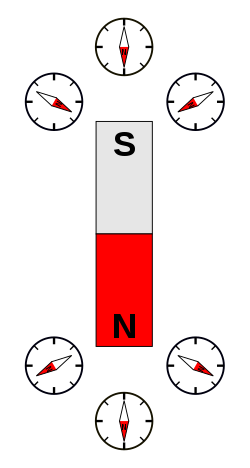
Deflection of compass when it is brought near a bar magnet
We can see that the red portion inside the bar magnet and the needle represents the North pole. And, the grey and white portions represent the bar magnet's South pole and the needle.
Why does a compass needle get deflected when brought near a bar magnet?
A compass needle gets deflected whenever a bar magnet is brought near to it. Because, a magnetic compass can be assumed as a pole, and the magnet creates a magnetic field. If we place both a compass and the magnet at rest, the compass will be reflected in a direction and constant.
Steps:
- Take a straight, thick copper wire and fix it between the point X and Y in an electric circuit, as shown in the below figure.
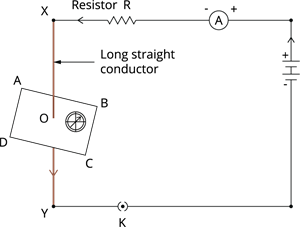
Electric circuit
Observation:
We observe that the needle is deflected.
It means that the electric current flows through the copper wire have induced a magnetic effect. Thus, we can state that electricity and magnetism are connected.
A magnetic field is an area around moving electric charges, electric currents, or magnetic materials within which the force of magnetism acts.
It can be represented by "B", and the unit is Tesla. A moving charge in a magnetic field undergoes a force perpendicular to its velocity and the magnetic field.
Magnetic field lines:
Magnetic field lines are a visual tool used to represent magnetic fields. They describe the direction of the magnetic force on a North monopole at any given position.
Properties of magnetic field lines:
- Magnetic field lines never intersect each other.
- The density of the field lines shows the strength of the field.
- Magnetic field lines always make closed-loops.
- Magnetic field lines always emerge from the north pole and terminate at the south pole.
The south pole of the needle moves towards the north pole of the bar magnet. The north pole of the compass is pointed away from the north pole of the bar magnet.
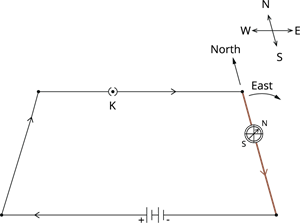
Direction of the field produced
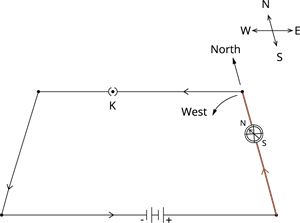
Direction of the field produced when current reversed
we can see that now the needle moves in the opposite direction, that is, towards the west [see the figure]. It means that the direction of the magnetic field produced by the electric current is also reversed.
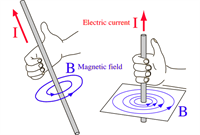
Magnetic field around a wire
The central arrow represents the direction of the current in the conductor. The circles are field lines, and the arrows show their direction on the lines. Similar to electric field lines, the greater the number of lines (or the closer they are together) in an area, the stronger the magnetic field. If there is no current, there will be no magnetic field.
PYQ:
Exam tips:
- Concnetrate on AR questions
- Definitions/Hint words
- Diagram
- Field pattern