

What is Electricity?
- Electricity is a form of energy produced by the movement of electric charges (electrons).
- It is called a versatile form of energy because it can be easily converted into other forms of energy.
Energy Conversion:
| Appliance | Input Energy | Output Energy |
|---|---|---|
| Bulb | Electrical | Light |
| Heater | Electrical | Heat |
| Fan | Electrical | Mechanical (Motion) |
| Television | Electrical | Light and Sound |
Uses of Electricity:
Electricity is used every day in homes, schools, hospitals, and industries.
- Lighting: Bulbs, tube lights
- Heating: Iron, heater, kettle
- Cooling: Fan, refrigerator, air conditioner
- Running Machines: Mixer grinder, washing machine
- Communication & Entertainment: Mobile phones, television, computers
Sources of Electricity:
1. Renewable Sources (Can be replaced naturally):
- Solar energy
- Wind energy
- Hydroelectric energy
Advantages:
- Can be used again and again
- Cause less pollution
- Environment-friendly
2. Non-renewable Sources (Limited)
- Coal (Thermal power)
- Petroleum
- Natural gas
Disadvantages:
- Limited supply
- Cause pollution
- Take millions of years to form
Electric Cell and Battery:
Electric Cell:
An electric cell is a portable source of electrical energy.
It has two terminals:
- Positive (\(+\)) \(\to\) Raised metal cap
- Negative (\(–\)) \(\to\) Flat metal disc
Battery:
A battery is made by connecting two or more cells together.
Correct Connection:
- Positive terminal of one cell \(\to\) Negative terminal of the next cell.
Filament Lamp and LED:
Filament Lamp:
- Has a thin filament.
- Current heats the filament.
- Hot filament glows and produces light.
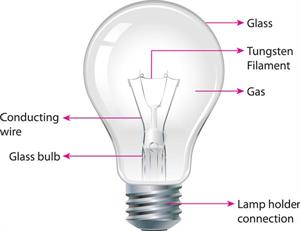
Filament lamp
LED (Light Emitting Diode):
- Has no filament.
- Works only when connected in the correct direction.
- Longer wire \(\to\) Positive terminal
- Shorter wire \(\to\) Negative terminal
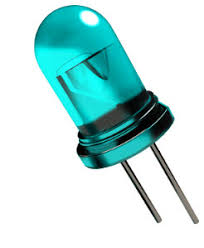
LED lamp
Electric Circuit:
An electric circuit is a closed path through which electric current flows.
Current flows:
Positive terminal \(\to\) Wires \(\to\) Bulb \(\to\) Negative terminal
Positive terminal \(\to\) Wires \(\to\) Bulb \(\to\) Negative terminal
Components of a Circuit:
- Electric Cell – Source of electrical energy.
- Connecting Wires – Carry electric current.
- Bulb/Lamp – Converts electrical energy into light.
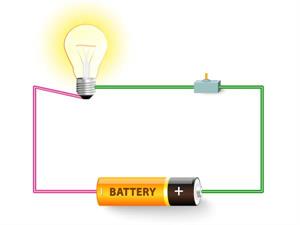
Simple electric circuit
Closed Circuit:
- Complete path
- Current flows
- Bulb glows
Open Circuit:
- Path is broken
- Current does not flow
- Bulb does not glow
Electric Switch:
A switch controls the flow of current.
- Switch ON \(\to\) Circuit closed \(\to\) Bulb glows.
- Switch OFF \(\to\) Circuit open \(\to\) Bulb does not glow.
Circuit Diagrams:
Instead of drawing real objects, we use standard circuit symbols.
Advantages:
- Easy to draw
- Easy to understand
- Used by scientists and engineers worldwide
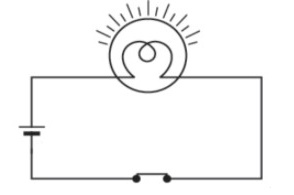
Circuit diagram