

Electric current:
Electric current is the flow of electric charges (electrons) in an electric circuit. Electricity occurs from the movement of electric charge.
The formula for electric current is:
\( I=\frac{Q}{t}\)
Where,
- \(I\) = Electric current (measured in ampere, \(A\))
- \(Q\) = Electric charge (measured in coulomb, \(C\))
- \(t\) = Time (measured in seconds, \(s\))
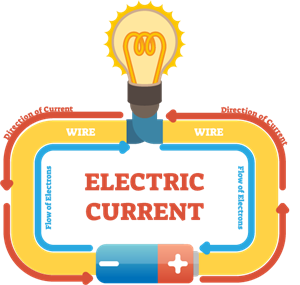
Flow of charges and current
Electric cell and battery:
Have you ever looked closely at a torch cell? If you observe it carefully, you will notice two ends. One end has a small raised metal part, and the other end is flat. These two ends are called terminals.
Every electric cell has two terminals:
-
The positive terminal (\(+\)) → the raised metal cap
-
The negative terminal (\(–\)) → the flat metal disc
An electric cell is a portable source of electrical energy, which means it can be easily carried and used in devices like torches, clocks, and remotes.

A cell
What is a battery?
Sometimes, one cell is not enough to provide energy. So, we use two or more cells together. When cells are connected properly, they form a battery.
In a battery:
-
The positive terminal of one cell is connected to the negative terminal of the next cell
-
This arrangement provides more energy and helps devices work for a longer time
That is why torches usually use more than one cell.

A battery
Activity: To understand how cells should be arranged in a torch to make it work.

A torch
Step 1: Open the torch and take out the cells.
Step 2: Observe how the cells are placed inside.
Step 3: Now place the cells in a different order.
Step 4: Try reversing the direction of one cell.
Step 5: Close the torch and switch it on.
Step 6: Check whether the bulb glows or not.
Step 7: Arrange the cells again and find the correct position where the bulb glows.

Battery in correct order
Observation:
-
The bulb glows only when the cells are arranged correctly.
-
When the cells are placed in the wrong order, the bulb does not glow.
-
The correct arrangement is when the positive terminal of one cell touches the negative terminal of the next cell.
Conclusion:
Cells must be connected in a proper order to form a battery. Only then can electricity flow through the circuit and make the bulb glow. This shows that the correct connection of terminals is very important for any electrical device to work.