

Electric circuit:
An electric circuit is a continuous and closed path through which electric current flows from one terminal of a cell to the other.
When we connect the components properly, the electric current starts from the positive terminal (\(+\)) of the cell, passes through the wires and the bulb, and returns to the negative terminal (\(–\)).
If this path is complete, current flows and the bulb glows.
If there is even a small break, current cannot flow and the bulb will not glow.
If there is even a small break, current cannot flow and the bulb will not glow.
Components of an electric circuit:
1. Electric cell:
The electric cell is the source of energy in a circuit. It provides the electrical energy needed to move charges (electrons).
It has two terminals:
It has two terminals:
- Positive terminal (\(+\)) – from where current starts
- Negative terminal (\(–\)) – where current ends
Without a cell, no current can flow in the circuit.
2. Connecting wires:
Connecting wires are made of materials like copper, which allow current to pass easily.
They act as paths or bridges that connect all the components of the circuit.
They act as paths or bridges that connect all the components of the circuit.
If a wire is loose or broken, the circuit becomes incomplete and stops working.
3. Lamp (Bulb):
The bulb is the device that uses electrical energy to produce light.
Inside the bulb, there is a very thin wire called a filament.
Inside the bulb, there is a very thin wire called a filament.
- When current passes through the filament, it becomes very hot
- Due to this heat, it starts to glow and produce light
If the filament breaks, the bulb becomes fused, and current cannot pass through it.
Closed circuit and open circuit:
Closed circuit:
A closed circuit is one in which the path is complete from the cell to the bulb and back.
- Current flows continuously
- Bulb glows
Open circuit:
An open circuit has a break or gap in the path.
- Current cannot flow
- Bulb does not glow
Even switching OFF the switch creates an open circuit.
Electric switch:
A switch is a simple device used to control the flow of electric current in a circuit.
Working of a Switch:
- When the switch is in the ON position:
- It closes the circuit
- The path becomes complete
- Current flows → Bulb glows
- When the switch is in the OFF position:
- It opens the circuit
- The path is broken
- Current stops → Bulb does not glow
In daily life, switches in our homes work on the same principle.
Circuit Diagrams:
Instead of drawing real objects, we use standard symbols to represent circuit components.
This makes it easier to draw, understand, and communicate circuits clearly.
This makes it easier to draw, understand, and communicate circuits clearly.
| Sl.No | Electrical component | Symbol |
| 1. | Cell |  |
| 2. | Bulb |  |
| 3. | Battery |  |
| 4. | Switch-On |  |
| 5. | Switch-Off |  |
|
6.
|
Wire |  |
Symbols of simple electric circuit
Activity: Making and testing a simple circuit
Aim: To understand how a closed circuit allows current to flow and makes a bulb glow.
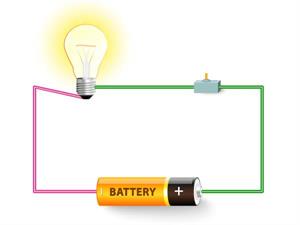
A simple electri circuit
Step 1: Take an electric cell and observe its positive and negative terminals.
Step 2:Connect one end of a wire to the positive terminal of the cell.
Step 3:Connect the other end of this wire to one terminal of the bulb.
Step 4:Connect another wire from the second terminal of the bulb to the switch.
Step 5:Now connect the switch to the negative terminal of the cell.
Step 6:First, keep the switch in the OFF position and observe the bulb.
Step 7:Then, turn the switch ON and observe again.
Observation:
- When the switch is OFF, the bulb does not glow because the circuit is open.
- When the switch is ON, the bulb glows because the circuit becomes closed and current flows through the filament.
Conclusion:
- A bulb glows only when there is a complete path (closed circuit).
- If the circuit is broken (open circuit), current cannot flow and the bulb does not glow.
- A switch controls whether the circuit is open or closed.