

Incandescent (Filament) lamp
An incandescent lamp produces light when a thin filament inside it becomes hot and glows.
Structure
- Glass bulb – protects the filament
- Filament – thin wire that produces light
- Supporting wires – hold the filament
- Base (metal case and tip) – act as two terminals
Role of Filament
When electric current passes through the filament, it becomes very hot and glows, producing light.
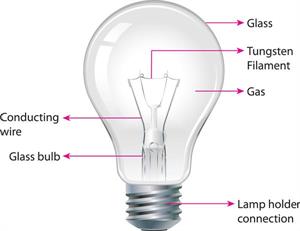
Parts of an incandescent lamp
2. LED Lamp
An LED lamp produces light without using a filament.
Structure
- LED chip – produces light
- Plastic cover/lens – spreads light
- Two wires (terminals)
Terminals
- Positive terminal (longer wire)
- Negative terminal (shorter wire)
LED glows only when connected in the correct direction.
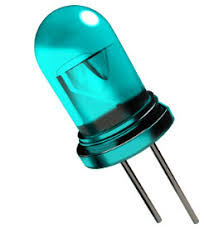
An LED
Comparison:
| Feature | Filament lamp | LED lamp |
| Energy Efficiency | Low | High |
| Heat Production | More heat | Less heat |
| Lifespan | Short | Long |
Activity: To observe and compare a filament lamp and LED
Procedure:
- Take a torchlight with a filament lamp.
- Observe the lamp carefully. Look for a thin wire (filament) inside the bulb.
- Switch on the torch and notice which part glows.
- With teacher’s help, remove the lamp and observe how the filament is connected to two terminals.
- Now take an LED and observe it.
- Check if there is any filament inside the LED.
- Observe the two wires of the LED and compare their lengths.
Observation:
- In the filament lamp, a thin wire (filament) is seen inside the bulb and it glows.
- The filament is connected to two terminals at the base.
- In the LED, there is no filament.
- The LED has two terminals: one longer (positive) and one shorter (negative).
Conclusion:
- A filament lamp produces light using a glowing filament.
- An LED lamp produces light without a filament and works only in the correct direction.
- Both lamps need a complete circuit to glow.