

Electricity in daily life:
Electricity is one of the most important forms of energy used in our daily life. It helps us operate many appliances and devices at home, school, hospitals, offices, and industries. We use electricity for lighting, heating, cooling, cooking, communication, entertainment, and transportation.
Many electrical appliances work using electricity:
- Bulbs and tube lights produce light.
- Fans provide cooling by producing movement.
- Heaters and electric irons produce heat.
- Televisions and radios produce sound and light.
- Refrigerators use electricity for cooling food.
Without electricity, many modern activities would become difficult. Electricity makes our work easier, faster, and more comfortable.
Electricity as a Form of Energy:
Electricity is a form of energy that can be converted into other forms of energy such as light energy, heat energy, sound energy, and mechanical energy.
Conversion into light energy:
When electricity passes through a bulb or LED lamp, electrical energy changes into light energy. This helps us see objects clearly in the dark.
Example:
Bulbs
Tube lights
LED lamps
Torchlights
Conversion into heat energy:
Some appliances convert electrical energy into heat energy.
Example:
Electric iron
Water heater
Toaster
Electric kettle
In these appliances, electricity produces heat which is used for useful purposes such as ironing clothes or heating water.
Electric Cell – A Portable Source of Electricity
An electric cell is a device that produces electricity using chemicals stored inside it. It converts chemical energy into electrical energy.
Electric cells are called portable sources of electricity because they are small, lightweight, and easy to carry from one place to another. They can provide electricity even in places where there is no direct electric supply.
Electric cells are commonly used in:
- Torchlights
- Remote controls
- Toys
- Wall clocks
- Radios
Terminals of an Electric Cell:
Every electric cell has two terminals called the positive terminal and the negative terminal. Both terminals are necessary for the flow of electric current in a circuit.
| Positive Terminal (\(+\)) | Negative Terminal (\(–\)) |
|---|---|
| Marked with a plus sign (\(+\)) | Marked with a minus sign (\(–\)) |
| Usually the raised end of the cell | Usually the flat end of the cell |
| Represented by the longer line in circuit symbols | Represented by the shorter line in circuit symbols |

An electric cell
Difference Between Electricity from a Cell and a Wall Socket:
Filament Lamp:
A filament lamp contains a very thin wire called a filament. When electric current passes through the filament, it becomes extremely hot and glows, producing light.
However, filament lamps waste a large amount of electrical energy as heat energy. This makes them less energy efficient.
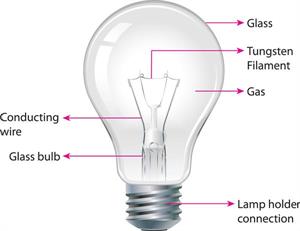
Filament lamp
LED Lamp:
LED stands for Light Emitting Diode. LED lamps produce light using less electrical energy.
LED lamps are more energy efficient because they convert most electrical energy into light and waste very little energy as heat.
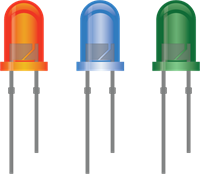
LED lamp
Comparison Between Filament Lamp and LED Lamp:
| Filament Lamp | LED Lamp |
|---|---|
| Uses more electricity | Uses less electricity |
| Produces more heat | Produces less heat |
| Less energy efficient | More energy efficient |
| Becomes very hot | Remains cooler |
| Shorter lifespan | Longer lifespan |