

Electricity is an important form of energy that helps us perform many daily activities. It is used to light our homes, operate fans, televisions, refrigerators, computers, and many other electrical devices. Electricity can be generated using different sources of energy. Some of these sources can be used again and again, while others are limited and may get exhausted over time.
Sources of Electricity:
Electricity is generated from different energy sources.
Thermal power plants mainly use coal to generate electricity.
These sources are classified into two types.
A. Renewable Sources of ElectricityRenewable sources are energy sources that are naturally replenished and can be used repeatedly without getting exhausted.
Solar Energy:
- Obtained from the Sun.
- Solar panels convert sunlight into electricity.
- Does not produce air pollution during electricity generation.
- Used in solar lamps, calculators, water heaters and rooftops.
Key Point
Solar energy is a clean and renewable source of electricity.
Wind Energy:
- Generated using moving air.
- Wind turbines rotate when wind blows.
- The turbines drive generators to produce electricity.
- Commonly used in windy coastal and hilly regions.
Key Point:
Wind energy is renewable because wind is naturally available.
Hydroelectric Energy:
- Produced using flowing or falling water.
- Water stored behind dams rotates turbines.
- Turbines drive generators to produce electricity.
- One of the largest renewable sources of electricity.
Key Point
Hydroelectric power uses the energy of moving water without burning fuels.
B. Non-renewable Sources of Electricity:
Non-renewable sources are available in limited amounts and take millions of years to form. Once used, they cannot be replaced quickly.
Thermal Energy:
Working:
- Coal is burned.
- Heat converts water into steam.
- Steam rotates turbines.
- Turbines rotate generators.
- Generators produce electricity.
Key Point:
Coal is a non-renewable fossil fuel because it cannot be replaced in a short time.
Torchlight:
A torchlight is a portable electrical device that produces light using dry cells (batteries).
Main Parts of a Torch
- Battery (Dry Cells)
- Switch
- Bulb (Lamp)
- Reflector
- Connecting strips/wires
Function of Each Part
| Parts | Function of each part |
| Battery (Dry Cells) |
|
| Bulb (Lamp) |
|
| Switch |
|
| Reflector |
|
How Does a Torch Work?
When the switch is turned \(ON\):
- The circuit becomes complete.
- Electric current flows from the battery to the bulb.
- The filament becomes hot.
- The bulb glows.
When the switch is turned \(OFF\):
- The circuit breaks.
- Current stops flowing.
- The bulb does not glow.
Electric Cell and Battery:
Electric Cell:
An electric cell is a device that converts chemical energy into electrical energy.
Every electric cell has:
- Positive (\(+\)) terminal
- Negative (\(–\)) terminal
The positive terminal is usually raised, while the negative terminal is flat.
Battery:
A battery is made by connecting two or more electric cells together.
Why do we use a battery?
- Supplies more electrical energy.
- Helps electrical devices work for a longer time.
- Used in torches, clocks, toys and remote controls.
Difference Between an Electric Cell and a Battery:
| Electric Cell | Battery |
|---|---|
| Single source of electrical energy | Two or more electric cells connected together |
| Supplies a smaller amount of electrical energy | Supplies more electrical energy |
| Used in simple devices | Used in devices requiring more power |
Simple Electric circuit:
An electric circuit is a complete and closed path through which electric current flows.
Electric current flows only when the circuit is complete.
Components of a Simple Electric circuit:
- Electric cell or battery
- Connecting wires
- Bulb (Lamp)
- Switch (optional)
Each component has a specific function.
| Components | Function |
| Electric Cell | Supplies electrical energy. |
| Connecting Wires | Provide a conducting path for electric current. |
| Bulb | Converts electrical energy into light energy. |
| Switch | Controls the flow of electric current. |
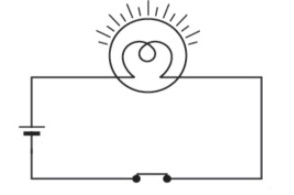
A simple electric circuit
Types of Electric circuit:
| Closed circuit | Open circuit |
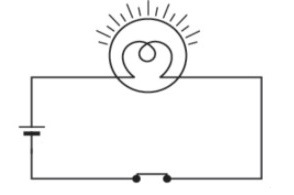 Closed circuit
|
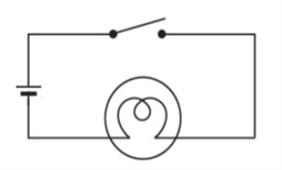 Open circuit
|
Making an Electric Lamp glow:
A bulb glows only when all the following conditions are satisfied:
- The electric cell is working.
- The bulb is not fused.
- The connecting wires are properly connected.
- The switch is ON (closed).
- The circuit is complete.