

Simple Pendulum:
A simple pendulum consists of a bob suspended from a fixed support by a string, allowing the bob to move to and fro.
When the bob is displaced slightly from its resting position and released without pushing it, it moves repeatedly from one side to the other.
This repeated to-and-fro motion is called oscillatory motion.
Parts to identify:
- Fixed support – the point from which the string is suspended.
- String – connects the support to the bob.
- Bob – the heavy object attached to the string.
- Mean position (O) – the central resting position of the bob.
- Extreme positions (A and B) – the two farthest positions reached by the bob.
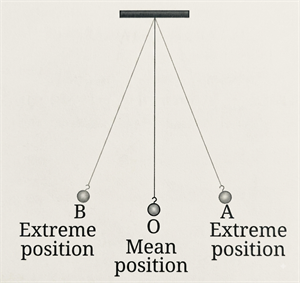
A simple pendulum
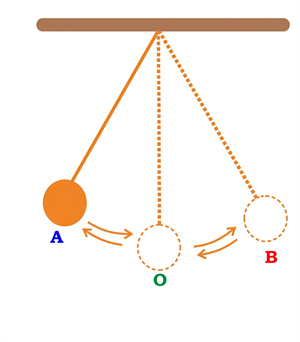
Swinging position of simple pendulum
What is One Oscillation?
Suppose the pendulum starts at extreme position \(A\).
It moves:
\(A\)\(\to\) \(O\) \(\to\) \(B\) \(\to\) \(O\) \(\to\) \(A\)
When the bob returns to its starting position \(A\) after reaching the opposite extreme position \(B\), it has completed one complete oscillation.
The movement from \(A → O → B\) is not one complete oscillation. The bob must return to its starting position.
Time period of a Simple Pendulum:
If a pendulum takes \(t\) seconds to complete \(N\) oscillations:
The time period of a pendulum is the time taken to complete one complete oscillation.
It is represented by \(T\).
Formula:
\(T=\frac{t}{N}\)
Example:
Suppose a pendulum takes \(20\ s\) for \(10\ oscillations\).
\(T=\frac{20}{10}\)
\(T=2\ s\)
Therefore, one oscillation takes \(2\ seconds\).
Measuring the Time period:
Experimental procedure:
- Take a string, bob, stopwatch/watch and ruler.
- Fix the string to a rigid support.
- Keep the pendulum length around \(100\ cm\).
- Allow the bob to come to rest.
- Displace the bob slightly to one side.
- Release it without pushing.
- Allow it to oscillate.
- Measure the time taken for \(10\ complete\ oscillations\).
- Repeat the measurement \(3–4\ times\).
- Calculate:
\(T=\frac{Time for 10 oscillations}{10}\)
Why measure 10 oscillations instead of one?
Because measuring only one oscillation involves a very short time interval. Small delays in starting and stopping the stopwatch can produce a relatively large error.
Measuring several oscillations gives a larger total time, so the effect of small timing errors becomes relatively smaller.
Factors Affecting Time period:
“What might happen to the time period if we change something about the pendulum?”
The main factor investigated at this level is the length of the pendulum.
Length:
The length of a pendulum affects its time period.
A change in length can produce a change in the time taken for one oscillation.
What about mass?
If the length is kept the same, changing the mass of the bob does not significantly change the time period in the investigation.
Fair experiment:
If we want to investigate the effect of length, we should:
- Change only the length.
- Keep the mass of the bob the same.
- Keep other relevant conditions the same.
SI Unit of Time:
The SI unit of time is the \(second\).
Symbol: \(s \)
Correct writing: \(5\ s\)
not:
- \(5\ S\)
- \(5\ Sec\)
- \(5\ sec. \)as a unit symbol
The SI symbol \(s\) is written in lowercase and is not followed by a full stop.
Common conversions:
\(1\ minute\ =\ 60\ s\)
\(1\ hour\ =\ 60\ min\)
\(1\ hour\ =\ 3600\ s\)
Ghatika or Ghati – Ancient Indian Time Measurement:
It shows that people in ancient India developed practical methods to measure time using naturally occurring or repeating processes.
Before modern clocks, people used different methods to measure time.
The Ghatika/Ghati is an example of an ancient Indian time unit and traditional method of time measurement.
A Ghatika-yantra was a traditional water-based time-measuring device. It used the regular movement of water to measure intervals of time.
Why is this important?
Modern Clocks and Atomic Clocks:
For everyday activities, ordinary clocks are sufficient. But some scientific and technological applications require extremely precise measurement of time.
Atomic clocks:
Atomic clocks use highly regular atomic processes as a precise reference for measuring time.
They are much more precise than ordinary clocks.
Applications of highly precise time measurement:
Accurate time measurement is important in areas such as:
- Scientific experiments
- Modern communication systems
- Navigation and positioning
- High-speed technology
- Comparing very closely timed events
Why Measure Tiny Fractions of a Second?
Sometimes a difference of even a tiny fraction of a second can matter.
Example: Sports
Imagine two runners finish almost together.
Runner \(A\): \(10.21\ s\)
Runner \(B\): \(10.23\ s\)
Difference: \(10.23 − 10.21 = 0.02\ s\)
Only \(0.02\ s\) separates them.
Therefore, measuring only whole seconds would not be enough.
Smallest Time Interval of a Wall Clock:
A common wall clock has:
- Hour hand
- Minute hand
- Second hand
The second hand provides the finest direct reading.
A complete revolution of the second hand takes: \(60\ s\)
The clock face has \(60\) equal divisions.
Therefore:
\(\frac{60\ s}{6} = 1\ s\)
So the smallest directly measurable interval using the ordinary wall clock is approximately: \(1\ s\)