

What is Measurement of Time?
Time measurement means determining how long an event takes or identifying when an event occurs.
Long ago, people did not have clocks or watches. They observed that many events in nature repeat after definite intervals of time. These repeating events became the basis of early timekeeping.
Natural events used for timekeeping:
- Rising and setting of the Sun \(\to\) helped define a day
- Phases of the Moon \(\to\) helped track longer periods
- Changing seasons \(\to\) helped track years
Initially, people developed calendars. Later, they needed devices to measure smaller intervals of time within a day.
Ancient devices for Measuring Time:
People developed several simple devices to measure shorter intervals of time.
| Device | Principle of Working |
|---|---|
| Sundial | Measures time using the changing position of the shadow of an object due to sunlight. |
| Water clock | Measures time using the flow of water or changing water level. |
| Hourglass | Measures time using the flow of sand from one bulb to another. |
| Candle clock | Uses the burning of a marked candle to indicate the passage of time. |
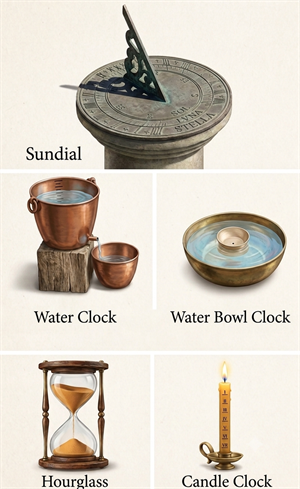
Ancient devices for measuring time
Sundial and Samrat Yantra:
A sundial determines time by observing the changing position of the shadow of an object cast by sunlight.
As the apparent position of the Sun changes during the day, the shadow also changes its position. A scale marked on the sundial allows the position of the shadow to be related to time.
Samrat Yantra:
The Samrat Yantra, located at Jantar Mantar in Jaipur, is the world's largest stone sundial.
Important facts:
- It was built around \(300\ years\) ago.
- It is about \(27 metres\) high.
- Its shadow moves at about \(1\ millimetre\ per\ second\).
- Its scale can measure time intervals as short as about \(2\ seconds\).
- It measures local solar time.
- A correction is required to obtain Indian Standard Time (IST).
Making a Simple Water Clock:
A simple water clock can be made using a used transparent plastic bottle.
Steps:
- Take a \(1/2\) \(litre\) or larger transparent plastic bottle with its cap.
- Cut the bottle into two parts.
- Make a small hole in the cap using a drawing pin.
- Place the upper part in an inverted position over the lower half.
- Fill the upper part with water.
- Add a few drops of ink or colour so that the water level is clearly visible.
- Water begins to drip into the lower part.
- Using a watch, mark the water level after every one minute.
- Continue until all the water has dripped down.
The water clock is now ready.
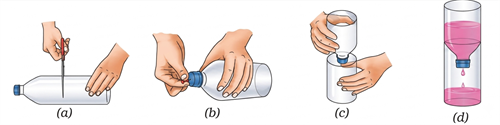
Making of simple water clock
How is it used?
Pour the water from the lower part back into the upper part.
As the water drips into the lower part:
Every time the water level reaches a marked line, one more minute has passed.
Thus, the changing water level acts as an indicator of the passage of time.
Ancient Indian Water Clocks:
Ancient India had important methods of measuring time using shadows and water clocks.
The Ghatika-yantra, or sinking-bowl water clock, was an important ancient Indian water clock.
How did it work?
A bowl with a small hole at the bottom was placed on the surface of water. Water gradually entered through the hole, causing the bowl to fill. After a fixed interval, the bowl sank.
The sinking of the bowl indicated that a particular interval of time had passed.
Where was it used?
The Ghatika-yantra was used in:
- Buddhist monasteries
- Royal palaces
- Town squares
- Religious places
When the bowl sank, the event could be announced using drums, conch shells, or a gong.
Limitation of early water clocks:
Early water clocks in which water flowed out were not very accurate because:
As the water level dropped, the flow rate decreased.
This variation in flow rate affected the accuracy of time measurement.
Development of Mechanical Clocks:
As human civilisation advanced, people began travelling longer distances and needed more accurate measurement of time.
From around the fourteenth century onwards, increasingly better mechanical devices were developed.
These clocks were driven by:
- Weights
- Gears
- Springs
However, a major breakthrough came with the development of the pendulum clock.
Galileo Galilei:
Galileo once noticed a lamp suspended from the ceiling of a church swinging back and forth. Using his pulse to measure time, he observed that the lamp took nearly the same amount of time for each swing.
He experimented with different pendulums and concluded that:
A pendulum of a given length takes the same time for each oscillation.
Why is this important?
The regular motion of the pendulum provided a reliable way of measuring time and became an important foundation for the development of the pendulum clock.
Christiaan Huygens:
Christiaan Huygens (\(1629–1695\)) was inspired by Galileo's investigations of pendulums.
He invented the pendulum clock in \(1656\) and patented it in \(1657\).
The pendulum clock was a major breakthrough in mechanical timekeeping because the regular oscillation of the pendulum allowed time to be measured much more accurately.
Timeline of Time Measurement:
A simple timeline can help students remember the development:
Natural cycles
\(\downarrow\)
Calendars
\(\downarrow\)
Sundials
\(\downarrow\)
Water clocks
\(\downarrow\)
Hourglasses & Candle clocks
\(\downarrow\)
Mechanical clocks
\(\downarrow\)
Pendulum clock
\(\downarrow\)
Modern clocks & watches
\(\downarrow\)
Calendars
\(\downarrow\)
Sundials
\(\downarrow\)
Water clocks
\(\downarrow\)
Hourglasses & Candle clocks
\(\downarrow\)
Mechanical clocks
\(\downarrow\)
Pendulum clock
\(\downarrow\)
Modern clocks & watches