

Electric devices work only when electric current flows through a complete circuit. By performing simple activities using electric cells, bulbs, LEDs, and connecting wires, we can understand how an electric circuit is formed and how current flows through it. They also explain why an incandescent lamp may fuse and why LEDs glow only in one direction.
Activity: Making an electric lamp glow using an electric cell or battery.
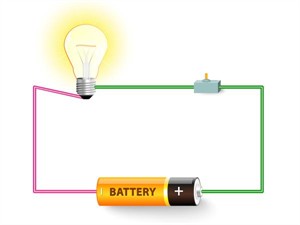
A simple electric circuit
Step 1: Take an electric cell, a torch bulb, four connecting wires, and holders if available.
Step 2: Remove about 1 cm of insulation from both ends of each wire.
Step 3: Connect two wires to the two terminals of the electric cell.
Step 4: Connect two wires to the two terminals of the bulb.
Step 5: Join the free ends of the wires from the cell and the bulb to form different connections.
Step 6: Observe whether the bulb glows and note your observations.
Observation:
- The lamp glows only when the two terminals of the electric cell are connected properly to the two terminals of the lamp, forming a complete circuit.
- If one terminal is left unconnected or both wires are connected to the same terminal of the lamp, the lamp does not glow.
- When the circuit is complete and correct, electric current flows through the filament of the lamp, causing it to glow.
Conclusion:
An electric lamp glows only when there is a complete and closed electric circuit connecting the two terminals of the cell to the two terminals of the lamp. If the circuit is incomplete or incorrectly connected, the lamp does not glow because electric current cannot flow.
Electrical circuit:
An electric lamp glows when one terminal of the lamp is connected to one terminal of the electric cell, and the other terminal of the lamp is connected to the other terminal of the cell. This arrangement forms an electrical circuit.
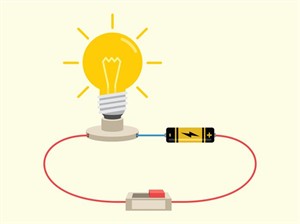
An electric circuit
Flow of electric current:
An electrical circuit provides a complete path through which electric current can flow. The lamp glows only when electric current passes through the circuit.
Direction of electric current:
By convention, the direction of electric current in a circuit is taken from the positive terminal to the negative terminal of the electric cell.
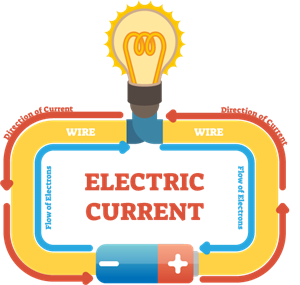
Direction of electric current
Glowing of an incandescent lamp:
When the terminals of the lamp are connected to the terminals of the electric cell using wires, electric current flows through the filament of the incandescent lamp, causing it to glow. In an incandescent lamp, it does not matter which terminal is connected to the positive or negative terminal of the cell. The lamp will glow as long as the circuit is complete and current flows through the filament.
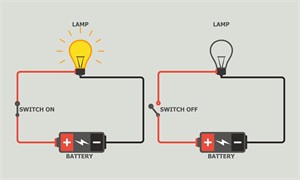
Glow of incandescent lamp
Fused lamp and broken filament:
Sometimes, an incandescent lamp does not glow even when it is properly connected to a cell. In such cases, we say that the lamp has fused, which usually happens due to a broken filament. A broken filament interrupts the flow of electric current, preventing the lamp from glowing.
Activity: Making an LED glow using two cells.
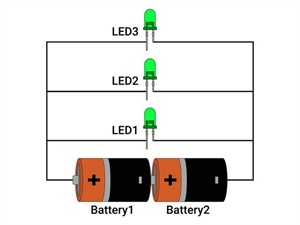
LED with longer and shorter legs
Step 1: Take two electric cells, a cell holder for two cells, an LED of any colour, and two pieces of electric wire.
Step 2: Remove about 1 cm of insulation from both ends of each wire.
Step 3: Connect the wires to the cell holder and insert the two cells, ensuring the negative terminal of each cell is towards the spring side.
Step 4: Identify the battery terminals: the terminal connected to the positive end of one cell is positive, and the terminal connected to the negative end of the other cell is negative.
Step 5: Connect the free end of the positive wire from the battery to the longer leg of the LED and the free end of the other wire to the shorter leg of the LED.
Step 6: Reverse the wires connected to the LED and observe the difference in glowing.
Observation:
- The LED glows only when its longer leg (positive) is connected to the positive terminal of the battery and the shorter leg (negative) is connected to the negative terminal.
- When the connections are reversed, the LED does not glow.
Conclusion:
An LED allows current to flow in only one direction. It glows only when connected correctly in a circuit, with its positive terminal to the positive end of the battery and negative terminal to the negative end.
Connecting cells placed side by side:
Sometimes, you may find a device where the cells are placed side by side. In such cases, the terminals of the cells are connected using a thick wire or metal strip that joins the positive terminal of one cell to the negative terminal of the next. To ensure correct placement, (\(+\)) and (\(-\)) symbols are usually printed inside the battery compartment.
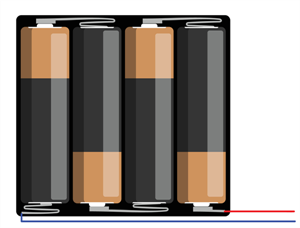
Cells connected side by side