

Have you ever noticed how the bicycle that you left under the Sun becomes too hot to touch? No one heated it directly, yet it became extremely warm. Was it due to conduction or convection? The real reason lies in a different type of heat transfer called radiation.
Let us know more about radiation.
- Heat travels through solids by conduction and moves through liquids and gases by convection. But radiation is different.
- It can transfer heat even through empty space, without needing any medium. That’s how the Sun’s heat reaches the Earth and heats the bicycle.
- All hot objects give off heat through radiation.
- When this heat reaches another object, some of it is reflected, some is absorbed, and some may pass through.
- However, the object's temperature will rise only if it absorbs the heat.
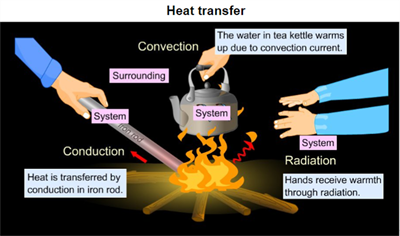
Modes of heat transfer
Radiation:
Radiation is the transfer of heat energy through invisible waves called electromagnetic waves. It doesnot need any medium like solid, liquid or gas. It can even transfer through empty spaces.
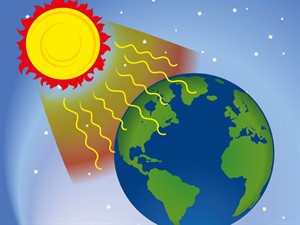
Radiation
Example:
-
Heat energy from the Sun reaches the Earth by radiation.
-
When a hot pan is kept away from the flame, the pan cools down as it transfers heat to the surroundings by radiation.
-
While standing near a fire, we feel the heat which is transferred as radiation.
-
Black surfaces absorb heat radiation. So that the bottom of the cooking vessels are painted black.
-
White colour reflects heat radiation. That’s why we are advised to wear white cloth during summer.
-
In a microwave, the foods are heated directly without any heating medium.
Have you ever wondered why we prefer wearing white clothes in summer and dark or black clothes in winter?
- It’s not just about fashion, it’s all about how colors react to heat.
- Different colors absorb and reflect heat differently, and that’s what helps keep us cool or warm depending on the season.
Activity:
To observe how different colors absorb heat differently through radiation.
Step 1: Take two small pieces of cardboard, one black and one white.
Step 2: Stick a small piece of butter at the center of each cardboard.
Step 3: Place both cardboards under the Sun and start the timer.
Step 4: Watch closely and observe which butter starts melting first.
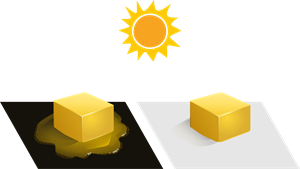
Melting butter under the Sun
- The butter on the black cardboard melts faster.
- The black cardboard absorbs more heat, while the white cardboard reflects it. This explains why dark clothes feel hotter and light clothes keep us cool, especially in summer.
A hot summer:
During summer, the heat from the sun is intense, making us feel hotter. During this time, wearing light-coloured clothes, such as white, helps us stay comfortable.

Light-coloured clothes in hot summer
This is because light-coloured clothes reflect most of the sun’s radiation, keeping our bodies cooler. In contrast, dark-coloured clothes absorb more of the sun’s heat, making us feel warmer and more uncomfortable.
A cold winter:
During the winter season, the Earth receives less heat from the sun, which is why we feel colder. Wearing dark-coloured clothes, such as black, helps us stay warmer during this time.

Dark-coloured clothes in cold winter
This is because dark colours absorb more heat, and when an object absorbs heat, its temperature increases, making us feel more comfortable in the cold.
Additionally, we often wear woollen clothes in winter because wool is a poor conductor of heat. It prevents the cold from outside from reaching our body, helping to retain body warmth. That’s why woollen clothes keep us more comfortable during cold weather conditions.