

Evaporation:
The process in which a liquid changes into gas on heating is called evaporation.
Transpiration:
The process by which plants lose water through tiny holes in their leaves is called transpiration.
Condensation:
The process in which gas changes into liquid by cooling down is called condensation.
Precipitation:
The process where water falls from the clouds to the Earth in the form of rain, snow or hail is called precipitation.
Water Cycle:
The continuous movement of water through different stages by which water vapour moves upwards and comes down as rain, moving through soil, rocks, plants, underground, finally to water bodies is called water cycle.
In this process the total water on the Earth is conserved through circulation, redistribution and restoration.
Seepage of water:
Seepage is the slow movement of water through the soil or tiny spaces in the ground. It happens when water slowly filters down through the soil and rocks, reaching underground layers. This process helps in recharging the groundwater.
Seepage of water in gravel, sand and clay:
| Property | Gravel | Sand | Clay |
| Image | 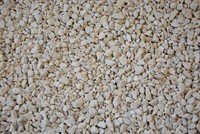 |
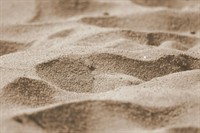 |
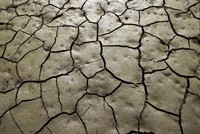 |
| Particle size | Large | Medium | Very tiny |
|
Space between particles
|
Large | Moderate | Very small |
| Flow of water | Fastest | Not too fast or too slow | Slow and may get trapped |
| Seepage | Fastest | Moderate | Slowest |
Infiltration:
Infiltration is the process by which water on the surface enters the soil. This happens after rainfall or when water is poured on the ground.The water moves downward through soil layers due to gravity. It is the first step in the movement of water into the Earth.
Groundwater:
Some of the water that infiltrates goes deep into the ground. This water fills the pore spaces between soil, rocks, and sand. This stored water is called groundwater.
Aquifers:
Aquifers are underground layers of rock or soil that store groundwater. These layers can store large amounts of water for a long time. Aquifers are like natural underground water tanks. Water from aquifers is used for drinking, farming, and daily needs by digging wells or drilling bore wells. This water may be a few metres to hundreds of metres below the ground, depending on the location.
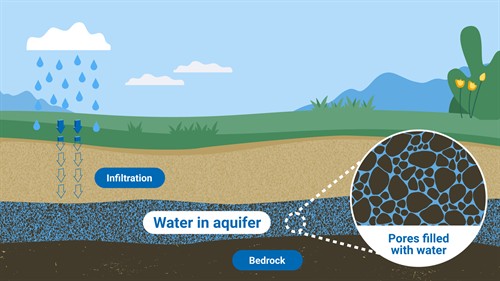
Aquifer
If water seeps into the ground and forms groundwater, can we keep using it forever?
No, groundwater is limited. As the population grows, more and more water is being taken out from the ground. At the same time, less vegetation and more concrete buildings and roads in cities have reduced the amount of rainwater that can seep into the ground. As a result groundwater is getting depleted.
How can we conserve groundwater?
- Rainwater harvesting and recharge pits are used to collect and store rainwater to recharge the ground.
- Reusing and recycling water to reduce demand on groundwater.
- Avoid wastage of water by turning off taps when not in use.
- Using drip irrigation to water plants and crops.