

Imagine you're a drop of water lying in a puddle. The Sun shines bright, and you float up into the sky as invisible light vapor. You travel through the fluffy clouds, fall as rain, and join a river on an exciting ride to the ocean. This never-ending journey is called the water cycle.
What is the water cycle?
- It's the natural process by which water circulates between the land, oceans, and the atmosphere.
- This cycle includes important stages like evaporation, transpiration, condensation, and precipitation.
- Water exists in three states: solid (ice), liquid (water), and gas (water vapor or steam).
- It changes from one form to another when we heat or cool it.
Stages of Water Cycle:
The water cycle involves four significant processes.
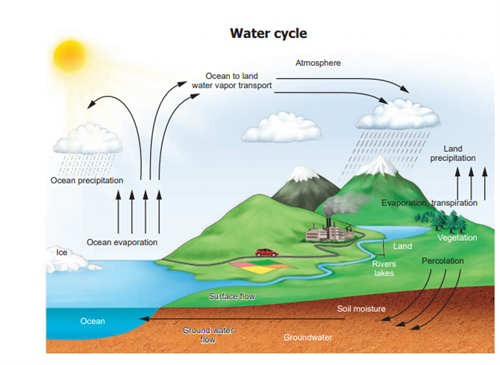
Water cycle
Evaporation:
The heat from the Sun heats up water in lakes, ponds, reservoirs, rivers, and oceans changing it into vapour which rises up in air.
The process in which a liquid changes into gas on heating is called evaporation.
Transpiration:
Plants contain water in their leaves. This water also evaporates into air as a vapour through tiny openings on it.
The process by which plants lose water through tiny holes in their leaves is called transpiration.
Condensation:
The water vapour that goes up into air is cooled down to form tiny water droplets to form clouds.
The process in which gas changes into liquid by cooling down is called condensation.
Precipitation:
The water droplets in clouds combine and become heavy. These fall back down to the Earth as rain.
The process where water falls from the clouds to the Earth in the form of rain, snow or hail is called precipitation.
Water Cycle:
The continuous movement of water through different stages by which water vapour moves upwards and comes down as rain, moving through soil, rocks, plants, underground, finally to water bodies is called water cycle.
In this process the total water on the Earth is conserved through circulation, redistribution and restoration.