

The next morning, Luke saw sunlight passing through his glass window but not through his book. The curtain let in only a little light. Curious, he asked his mother why that happened. She smiled and said, “Different materials allow light to pass through them in different ways. Some let all the light through, some let only a little, and some don’t let any light pass.”
Let us perform an activity to understand this.
Activity:
To observe how light passes through different materials.
Step 1: Take a torch and place it on a table.
Step 2: Hold a clear glass sheet in front of the light and observe.
Step 3: Now place a butter paper in front of the light and observe.
Step 4: Finally, hold a cardboard piece in front of the light and observe.
Observation:
- Light passes completely through the glass sheet.
- Light passes partly through the butter paper.
- Light does not pass through the cardboard.
Conclusion:
- The glass sheet is a transparent material.
- The butter paper is a translucent material.
- The cardboard is an opaque material.
Transparent:
The materials that allow light to pass completely through them are known as transparent.
Example:
Glass, clear water.
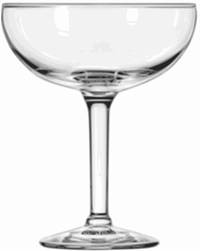
Glass
Translucent:
The materials that allow light to pass partially are known as translucent.
Example:
Butter paper, wax paper.
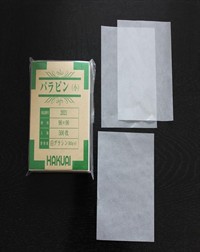
Wax paper
Opaque:
The materials that do not allow light to pass through are known as opaque.
Example:
Brick wall, cardboard, metal door.
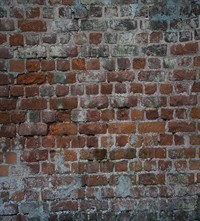
Brick wall
Later that evening, Luke played with his candlelight again. He noticed that when he placed his book in front of the light, a dark shape appeared on the wall behind it. Curious, he asked his mother why. She explained, “That dark patch is a shadow. It forms because the book is an opaque object and does not let light pass through. When light is blocked, a shadow is formed.” Luke smiled as he moved the book closer and farther, watching the shadow change in size!
Shadow:
A shadow is a dark patch formed when an opaque object blocks the path of light, which travels in a straight line. It is always formed at the opposite side of a light source.
- Opaque objects form dark shadows because they do not allow light to pass through.
- Translucent objects form light or faint shadows as they let some light pass.
- Transparent objects form very faint or no shadows because most of the light passes through them.
Let us perform an activity to observe the shadow formation.
Activity:
To observe the shape and size of the shadow formed by opaque objects.
Step 1: Collect a few opaque objects of different shapes and sizes.
Step 2: Using a torch, a screen and each object one by one, obseve how shadows are formed.
Step 3: Carefully watch the shape and size of the shadow on the screen and record the observations.
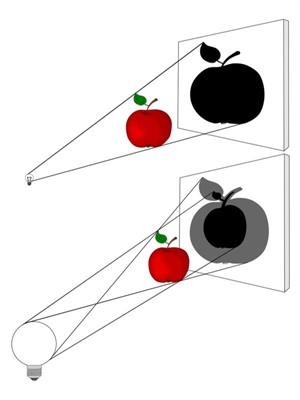
Shadow formation
Observation:
| Action | Observation regarding shadow |
| The screen is removed. | No shadow is formed because there is no surface for the shadow to fall on. |
| The object is removed. | No shadow is formed because nothing blocks the light. |
| The torch is switched off. | No shadow is formed because there is no light source. |
| The colour of the object is changed. | The colour of the shadow does not change, it remains dark. |
| The object is moved closer to the screen, keeping the torch and screen fixed. | The shadow becomes smaller and sharper. |
| The object is moved closer to the torch, keeping the torch and screen fixed. | The shadow becomes larger and less sharp. |
| The object is tilted, keeping the torch and screen fixed. | The shape of the shadow changes according to the object’s tilt. |
Conclusion:
- A shadow is formed when an object blocks light from falling on a screen.
- To observe a shadow, we need a source of light, an opaque object, and a screen.
- The shape, size, and sharpness of a shadow depend on the position of the object relative to the light source and the screen.
- Changing the colour of the object does not change the colour of its shadow.
In everyday life, walls, floors, or the ground can act as screens.
Sometimes, a shadow can give us information about the object, but not always clearly.