

One evening, Luke noticed a small bright spot moving on the wall when he held a shiny spoon. Curious, he asked his mother why.
She explained, “Sunlight is reflecting off the spoon. Shiny opaque surfaces don’t let light pass through, they bounce it back.”
“That’s the simple magic of reflection.”
Let us perform an activity to understand reflection.
Activity: To observe the reflection of light.
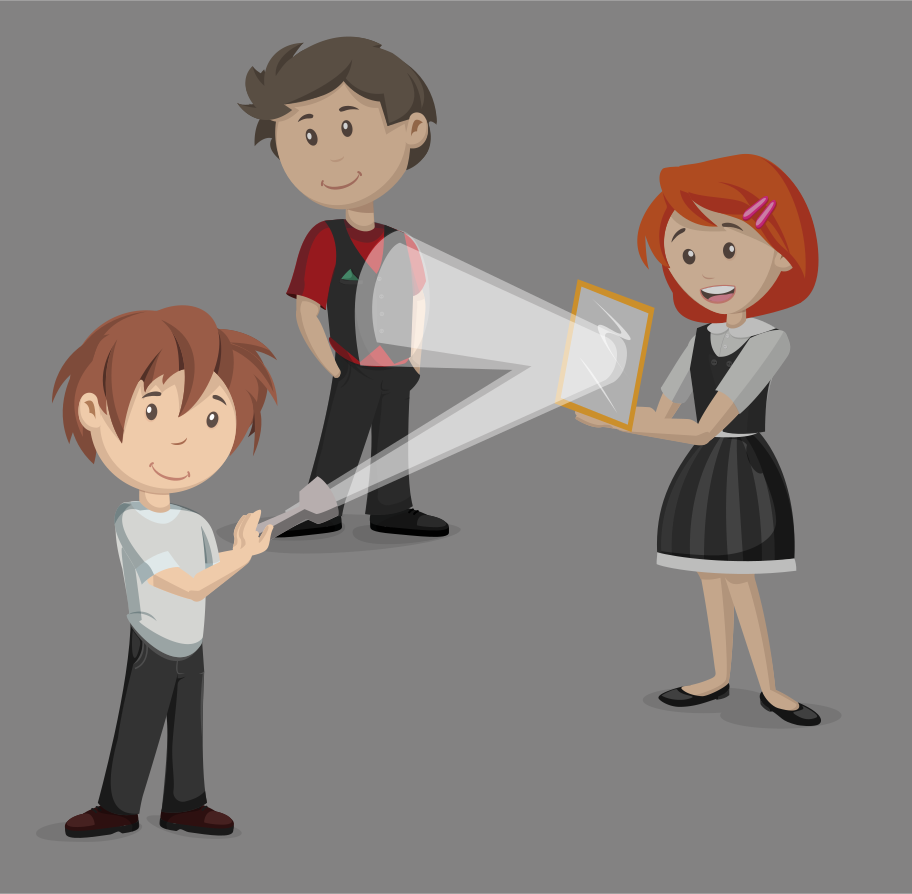
Step 1: Take the shiny steel plate or plane mirror and shine light on it using a torch.
Step 2: Hold it so that light falls directly on its surface.
Step 3: Slowly tilt or rotate the mirror in different directions.
Step 4: Try to make the reflected light fall on a wall or surface where light does not directly reach.
Step 5: Notice what happens to the patch of light as you change the mirror’s angle.
Observation:
You will see a bright spot of light appearing on another wall or surface. When you change the angle of the mirror, the bright spot also moves in the direction you tilt the mirror.
Conclusion:
A shiny surface such as a steel plate or plane mirror can change the direction of light falling on it. By adjusting the mirror, you can redirect the light to another place.
Reflection of light:
The change in direction of light after striking a mirror is called the reflection of light.
Let us perform an activity to understand this further.
Activity: To observe the changing path of light using a mirror.
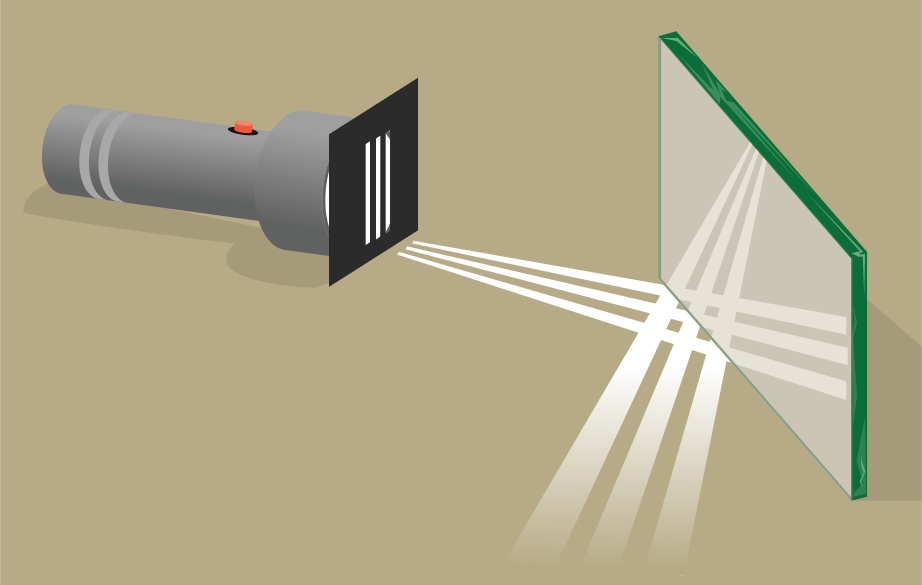
Light passing through a slit comb
Step 1: Cover a comb with black paper, leaving one narrow slit.
Step 2: Place a white sheet of paper on the table and hold the comb upright on it.
Step 3: Shine the torch through the slit to form a thin light beam on the paper.
Step 4: Without moving the comb, place a plane mirror in the path of the light beam.
Step 5: Observe how the beam changes direction after hitting the mirror.
Observation:
The narrow beam of light does not continue in the same direction. Instead, when it strikes the mirror, the beam is seen going in a new direction. This shows that the mirror has changed the path of the light.
Conclusion:
A mirror can alter the direction in which light travels. When light falls on a mirror, it does not pass through, it bounces off in another direction.
Light's reflection and its path:
- The path of the light beam is changed after falling on the mirror.
- The light does not pass through the mirror but it bounces off in a different direction.
- The reflection of light occurs at the mirror.
Activity: To observe how an image is formed in a plane mirror.
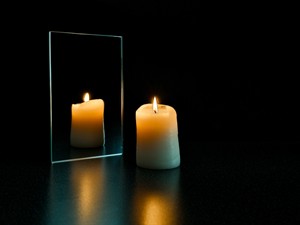
The image formation in a mirror
Step 1: Place a candle in front of a plane mirror.
Step 2: Observe the image formed behind the mirror.
Step 3: Move the candle to different positions and compare the size of the image each time.
Step 4: Observe whether the image remains upright at all positions.
Step 5: Place a screen behind the mirror and then in front of it to check if the image can be caught on the screen.
Observation:
A similar candle-like image appears behind the mirror, the candle is the object and the one seen behind is its image. The image size remains the same as the object no matter where the candle is placed. The image always remains upright (erect). The image cannot be obtained on a screen, whether placed behind or in front of the mirror.
Conclusion:
A plane mirror forms an image of the same size, which is erect, and cannot be captured on a screen because it is a virtual image.
Properties of a plane mirror:
-
The image formed is virtual (cannot be projected on a screen).
-
The image is of the same size as the object.
-
The image is laterally inverted (left and right are reversed).
-
The image appears at the same distance behind the mirror as the object is in front.
-
The image is upright (top and bottom are not inverted).
-
A plane mirror follows the laws of reflection.
Let us perform an activity to understand what lateral inversion means in a plane mirror.
Activity: To observe lateral inverion in a plane mirror.
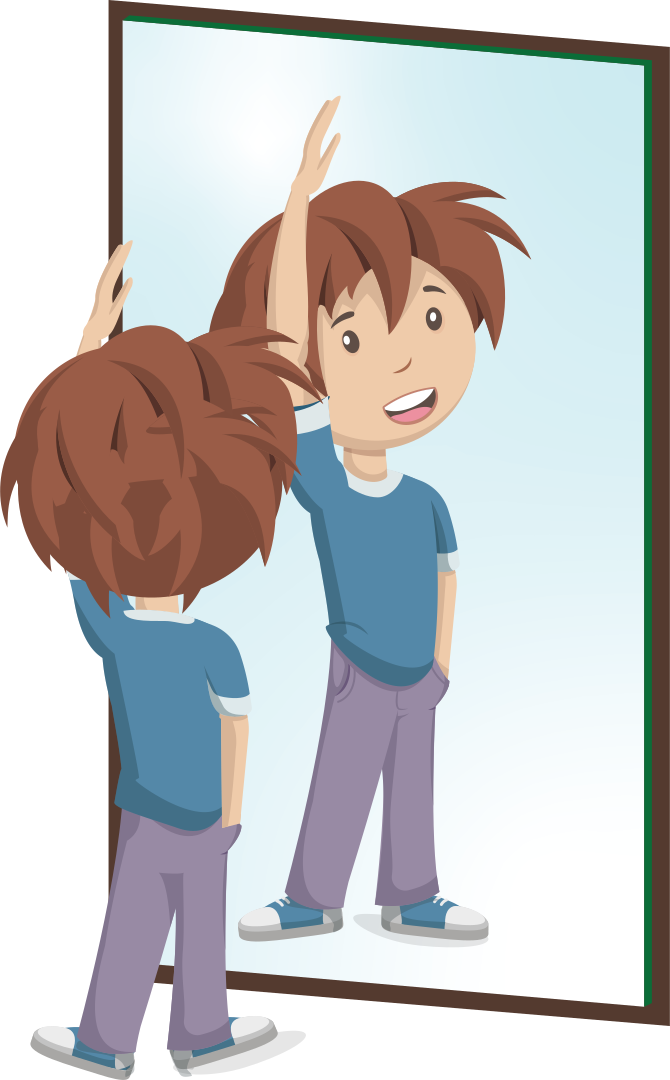
A boy observing his image in a plane mirror
Step 1: Stand in front of a plane mirror and observe how far your image appears from the mirror.
Step 2: Move closer to the mirror and check whether your image also seems closer.
Step 3: Stand at different distances and note the corresponding distance of the image each time.
Step 4: Raise your left arm and observe which arm your image raises.
Step 5: Touch your right ear and see which ear your image appears to touch.
Observation:
When you stand close to the mirror, your image also appears close, when you stand far, the image appears far. Your image raises the opposite arm (your left appears as its right). Touching your right ear makes the image appear to touch its left ear.
Conclusion:
The image distance from a plane mirror is equal to the object’s distance from the mirror. A plane mirror causes lateral inversion, where the left and right sides appear reversed.
Lateral inversion:
Lateral inversion is the left–right reversal seen in the image formed by a plane mirror, where the left side of the object appears on the right side of the image and vice versa.
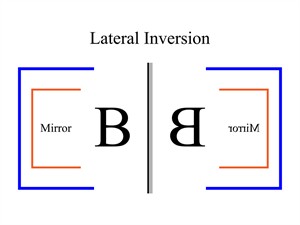
Lateral inversion
Example:
The word 'AMBULANCE' is written backwards in an ambulance van due to lateral inversion. This is because the drivers of other vehicles moving ahead of the ambulance can see the word 'AMBULANCE' in the right way around in their rear-view mirror and allow the vehicle to pass without blocking its path.


Lateral inversion in Ambulance
Important!
The exact time when mirrors were first invented is not known. In ancient times, people made mirrors by polishing stones or metals. Later, when glass mirrors began to be produced, the skill of making metal mirrors slowly faded away. However, this traditional craft still exists in some places, such as in Kerala, where the famous Aranmula Kannadi, a special handcrafted metal mirror, has been made for generations.
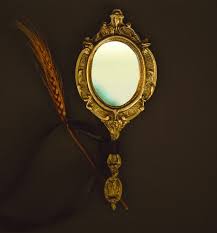
Aranmula Kannadi